
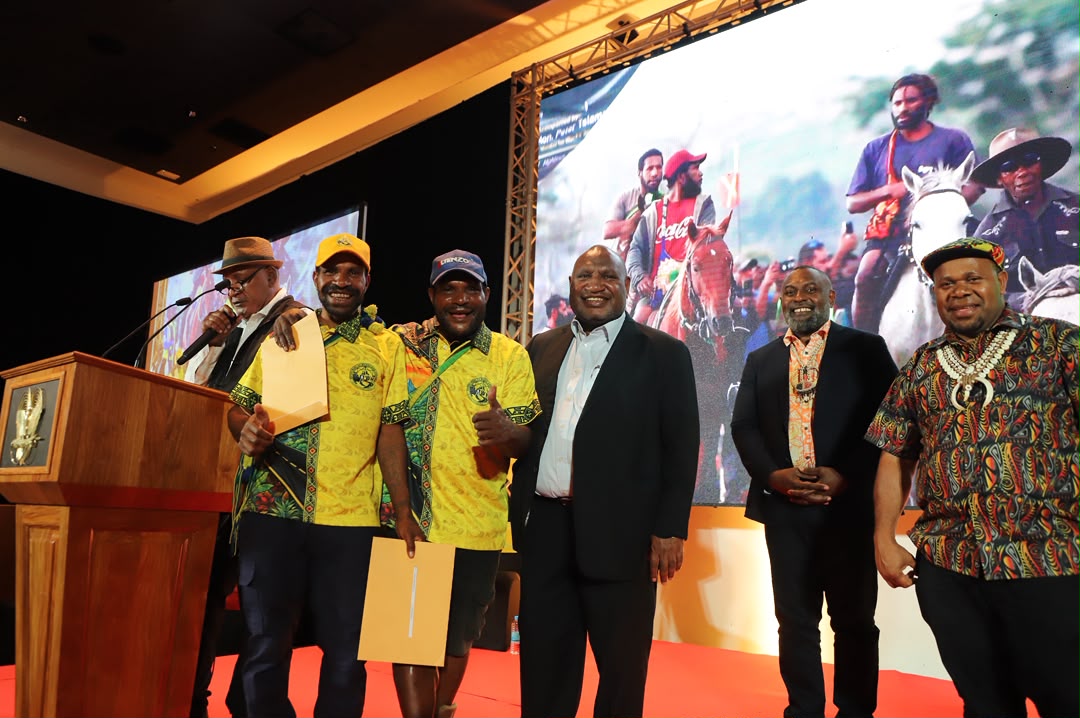

Prime Minister Hon. James Marape has hailed the Department of Works and Highways’ “Yellow Army” as an embodiment of the “Nogat Lesman” — everyone must work spirit he wants Papua New Guinea to carry into its next 50 years.
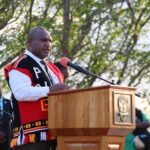
Speaking to Works and Highways staff on the eve of Papua New Guinea’s 51st Independence Anniversary, Prime Minister Marape said there remained an enormous amount of work to connect the country and bring development to people still living beyond basic infrastructure.
“You are amongst the shining lights, picking Government policy and translating and transforming Government policy to touch the lives of our people,” he said.“It is appropriate that on the last night before our 51st Independence Anniversary, we are with the Works Department — the department that embodies work.
“Whether James Marape stays or not, that spirit of work will carry us all the way into the future.”
‘YELLOW ARMY’ BUILDING PAPUA NEW GUINEA
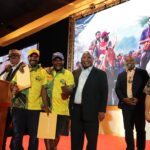
Prime Minister Marape described Works personnel as the country’s “Yellow Army”, saying their distinctive yellow work clothes represented the men and women physically building and connecting Papua New Guinea.
He said Papua New Guineans proudly supported the Kumuls because they united the country, but the Works “yellow jersey” also represented national service.
“The next 50 years must be built by men and women of our country who will shout out, ‘Nogat Lesman’. We must all work for our country,” he said.
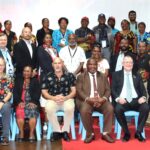
Prime Minister Marape acknowledged Works and Highways Minister Hon. Peter Tsiamalili Jr, former Ministers including Hon. Michael Nali and the late Hon. Solan Mirisim, former Secretary David Wereh and current Secretary Gibson Holemba.
He also thanked engineers, surveyors, project managers, machine operators, drivers, mechanics, fuel attendants, cooks, carpenters, labourers and other Works personnel serving throughout the country.
FROM KAINTIBA TO A ROAD CONNECTION
Prime Minister Marape recalled landing unexpectedly at remote Kaintiba in Gulf Province in 2020, where he encountered only four women, 11 children and one man.
He said the people initially did not know who he was.The encounter reinforced for him the reality that many Papua New Guineans remained physically isolated from the rest of the country.
He subsequently directed Works officials to pursue a road connection through the area towards Morobe.
Returning through the same country by road during the recent historic Port Moresby-to-Lae journey was therefore deeply personal.
“I didn’t promise them a superhighway. I promised them a road,” Prime Minister Marape said.“For people like James Marape, at least a road is a road.”
He said the experience represented the fundamental purpose of Connect PNG: to reach the unreached, connect the unconnected, and leave no place and no child behind.
‘I KNOW WHAT IT MEANS TO HAVE NO ROAD’
Prime Minister Marape said his commitment to rural connectivity was also shaped by his childhood.
He recalled being a young boy in Oksapmin in 1976 when his mother buried her son in a community without road access to the nearest hospital.
In 1978, he attended Grade One at Oksapmin Primary School and walked long distances to school.
“If someone had told James Marape in 1978, when I did my Grade One in Oksapmin Primary School, that you will be the country’s eighth Prime Minister, I would have laughed at him,” he said.“Lucky for me, I stuck by education on a highway called education — not a physical highway, but an educational highway.”
Prime Minister Marape said millions of children living in remote Papua New Guinea deserved the same opportunity to access education, health services and economic opportunities.
“If one rural boy from PNG could come out from the rural enclaves of our country, I am 100 per cent certain that thousands and millions of Papua New Guinean children out there must also be given equal opportunity,” he said.
ROADS MUST BUILD THE ECONOMY
Prime Minister Marape stressed that infrastructure investment must translate into increased economic production.
“Road brings education. Road brings health. Road grows the economy,” he said.“It is road and infrastructure that build the economy. It is the economy that builds the country. It is the country that builds citizens.”
He said roads must be complemented by electricity, telecommunications, ports, jetties, airstrips and airports to fully open economic corridors.
The Prime Minister recalled seeing bags of coffee beside the newly opened road through previously isolated communities during the recent journey through Gulf and Morobe.
He said this was precisely what road investment should achieve.
“Road must lead to economic activities because economic activities will help us pay down on the cost of the road as well as generate more income for future roads and infrastructure,” he said.
Prime Minister Marape called on communities benefiting from major road investments to use the connectivity to grow coffee and other crops, produce food, establish businesses and participate more actively in the economy.
He also directed the Department of Works and Highways to increasingly undertake economic analysis of roads to identify the productive activities each investment could unlock.
‘I NEED HONEST CONTRACTORS’
Prime Minister Marape directed the department to establish clear benchmarks for the cost of constructing different classes of roads in different parts of Papua New Guinea.
He said construction costs naturally varied according to terrain, geography, rainfall, materials and logistics, but the State needed reliable benchmarks to ensure value for money.
“I want you to calculate what is the cost of one kilometre of road for different classes of road in different parts of our country,” he said.“This must be in your inventory and in your department so that as we tender for roads and give contractors work, we supervise them well.”
The Prime Minister also issued a direct message to companies working on Government infrastructure projects.
“I need honest contractors. I need honest contractors,” he said.
CONNECT PNG MUST CONTINUE
Prime Minister Marape said the Government had placed Connect PNG within a legislative framework so that national road development continued beyond individual governments and leaders.
He said Papua New Guinea still needed decades of sustained investment in roads, bridges, ports, jetties, airports, airstrips, electricity and telecommunications.
“With or without James Marape, I am 100 per cent certain we will still be building,” he said.
The Prime Minister said his long-term vision was to progressively join the country’s fragmented road networks into major economic corridors.
He envisaged a future where people could travel by road from East Cape in Milne Bay through Port Moresby, Kerema, Lae, Madang and the Sepik to Vanimo and Wutung at the Indonesian border.
‘HAVE HOPE. HAVE FAITH IN YOUR COUNTRY’
Prime Minister Marape said the work of the “Yellow Army” reflected the broader message he would deliver to Papua New Guineans for the 51st Independence Anniversary.
The country’s next 50 years, he said, must be characterised by work, education, infrastructure development and economic production.
“Have hope. Have faith for your country,” Prime Minister Marape said.“Many sceptics think this country will fail, will not progress. But the country will live on with or without James Marape.”
He urged Works personnel to continue their mission of opening Papua New Guinea.
“Don’t give up on the foresight to reach the unreached, connect the unconnected, leaving no place and no child behind,” he said.
“Nogat Lesman. We must all work for our country.”