
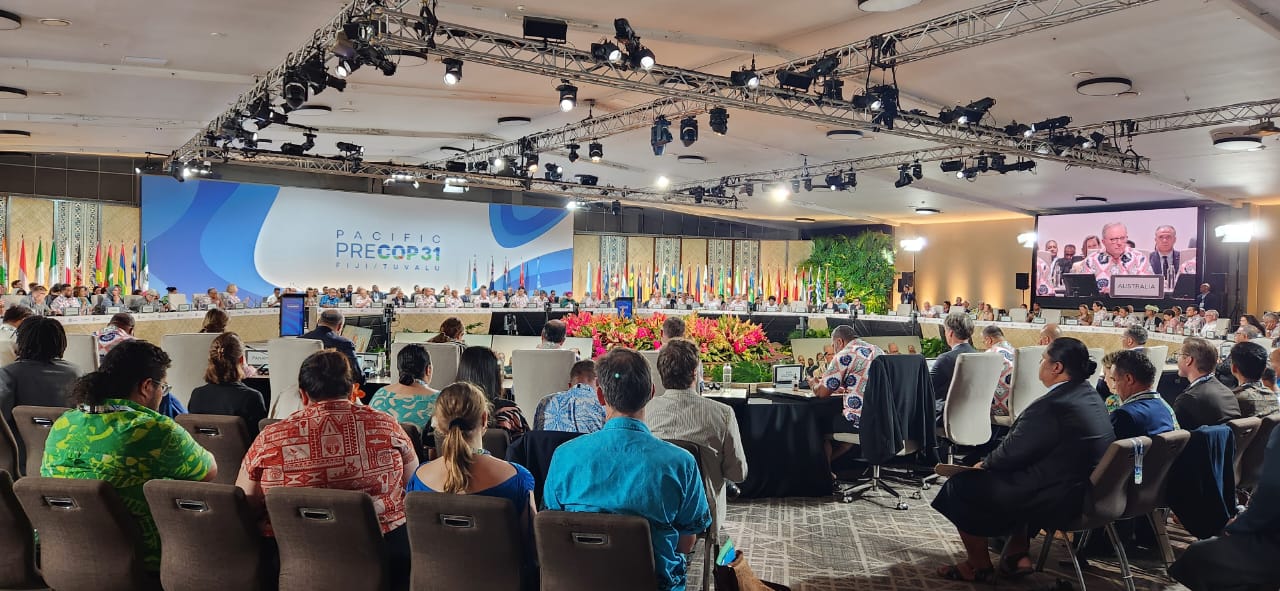

Papua New Guinea has secured critical financial commitments for regional funds and has established a joint Melanesian consensus on regional human rights at the Pre-COP31 meetings in Tuvalu and Fiji.
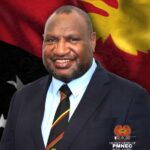
Prime Minister Hon. James Marape made the announcement in a press conference as he returned to the country from the meetings today.
Speaking at the Jacksons International Airport APEC Terminal, the Prime Minis- ter said that he utilised the preparatory sessions to press major global carbon emitters for financing proportional to their emissions while confirming he would not be attending COP31 in Turkey but Deputy Prime Minister John Rosso would instead be representing the country.
Regional Standing and Multilateral Advocacy
The Prime Minister emphasized that as the Pacific Island Forum’s (PIF) second- largest nation by landmass and population, and its third-largest economy, PNG positions itself at the frontline of both global environmental crises and strategic solutions.
“Climate change is affecting us directly through rising sea levels and highly un- predictable weather patterns,” he stated.
“PNG is an integral part of the PIF family, and as a major holder of ocean and forest resources, our active support to member countries and collective regional solutions is very necessary. When we are in need, it is the PIF that we run to so when PIF is in need, we must help. We belong to the one Pacific family.”
PM Marape noted that Papua New Guinea’s sustained advocacy over the past seven years across multilateral platforms has secured critical mitigation and adaptation partnerships with France, the European Union, and the Green Climate Fund (GCF), managing over K500 million in active climate program funding aligned with its Medium-Term Development Plan (MTDP). “It is in these sorts of meetings that you come into direct contact with advanced research, practical solutions, valuable networking, and key development partners,” Prime Minister Marape added.
Domestic Climate Programs and 2035 Targets
Prime Minister Marape detailed Papua New Guinea’s domestic climate initiatives, outlining that the government is actively executing the following targeted programs:
• Forest conservation: Protecting existing forest cover and generating economic earnings from standing trees.
• Ocean conservation: Implementing a 30×30 initiative to safeguard marine ecosystems.
• Land reclamation: Deploying sea walls and island reclamation projects for Mortlock and other vulnerable islands.
• Maritime infrastructure: Developing sustainable sea transport options for remote island communities.
• Energy transition: Achieving a full transition to clean energy generation across the country by 2035.
• Transport modernisation: Implementing electric vehicles, machinery, and updated transportation systems by 2035.
International Environmental Commitments
On international policy, Prime Minister Marape highlighted that Papua New Guinea is maintaining a K5 million annual bilateral support package over five years for land reclamation efforts in Tuvalu, alongside an initial US$5 million contribution to the Pacific Resilience Facility (PRF) with intentions for annual renewals. PNG is also keeping a strict moratorium on deep-sea mining, driving coral reef preservation initiatives, and actively collaborating with the United Nations on the Law of the Sea (UNCLOS).
Climate Financing and Fund Replenishment
During the Pre-COP sessions, PM Marape revealed that Papua New Guinea advanced bilateral talks with the GCF, acknowledging the fund’s US$1 billion portfolio across the Pacific region while calling for urgent capital replenishment and welcoming new financial commitments to regional mechanisms, including an A$100 million deposit from Australia and a US$10 million pledge from Fiji.
“I used these pre-COP meetings to advocate for big carbon footprint holders to assist climate-related activities with a size and scale that commensurates their global carbon emissions,” Prime Minister Marape stated.
“We want the PRF to establish a solid US$500 million facility, and we are combining our efforts across these preliminary sessions and the upcoming actual COP to get countries and companies to firmly commit to this fund for regional help programs like land reclamation, solar electricity, and clean water.”
Melanesian Spearhead Group and West Papua
On the margins of the summit, the Prime Minister stated that leaders of the Melanesian Spearhead Group (MSG) convened an informal meeting to address the human rights situation in West Papua.
He said the leaders resolved to issue a formal resolution addressing reported human rights abuses and requesting assurances from Indonesian authorities regarding the protection of Melanesian populations.
“These crucial matters were discussed with the fullest respect to Indonesia’s sovereignty and territorial integrity, where we openly acknowledged that Indonesia also has Melanesian people residing across several other provinces,” Prime Minister Marape noted.
The Prime Minister indicated he will advance these discussions with the Indonesian Ambassador to Papua New Guinea and directly with President Prabowo Subianto during the upcoming APEC summit.