

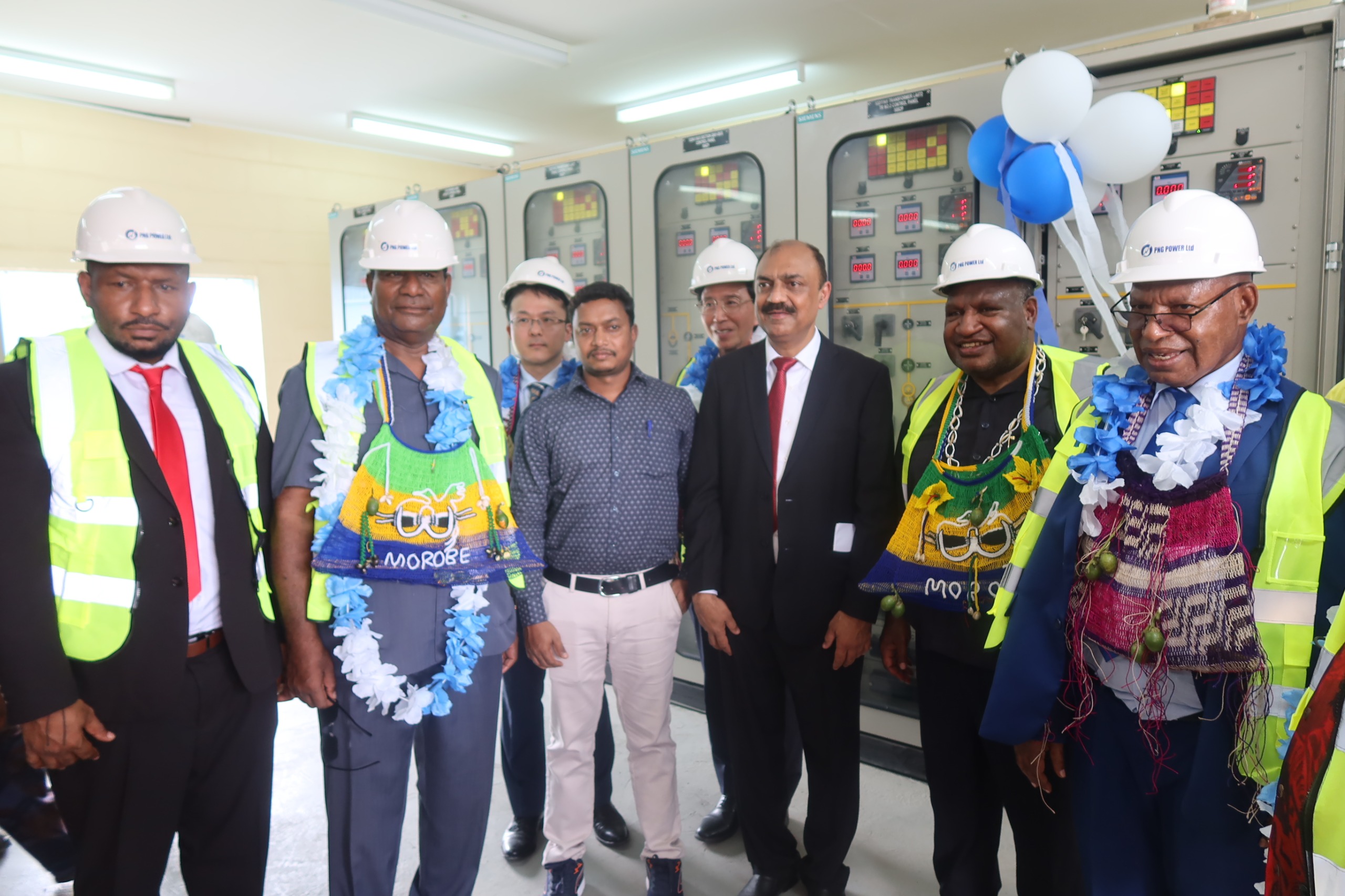

Prime Minister Hon. James Marape has called for massive private sector investment in electricity generation across Papua New Guinea following the completion of the K263 million Ramu Transmission System Reinforcement Project in Lae, declaring that reliable and affordable power is essential to achieving the Government’s ambition of building a K200 billion economy by 2030 and beyond.
Speaking at the official completion ceremony of the Japan International Cooperation Agency (JICA)-supported project at Taraka Substation today, Prime Minister Marape said the Government was deliberately investing billions of kina in roads, electricity transmission and telecommunications infrastructure to unlock the country’s economic potential.
The project, supported by a Japanese concessional loan commitment of ¥8.34 billion (approximately K237.2 million at indicative current exchange rates) through JICA and K54.7 million in counterpart funding from the Government of Papua New Guinea, represents a major investment in strengthening the Ramu electricity grid and improving power reliability.
It includes approximately 134 kilometres of additional 132kV transmission line, 326 transmission towers, telecommunications systems and upgrades to the Ramu Switchyard and Singsing, Erap and Taraka substations.
According to JICA, the reinforced transmission network is expected to substantially reduce transmission-related electricity outages in Lae and surrounding areas while increasing the capacity of the Ramu Grid to meet future demand.
The Marape-Rosso Government has spent more than K1.9 billion to date on the 132kV transmission network running from Tari through Mt Hagen and Yonki to Lae since taking office in 2019. This represents a major investment in an economic region that accounts for approximately 60 per cent of Papua New Guinea’s economic activity and population.
The project is also expected to contribute towards Papua New Guinea’s national target of achieving 70 per cent electricity access by 2030, supporting improved living standards and economic opportunities for approximately 3.4 million people.
Prime Minister Marape thanked the Government and people of Japan, particularly Japanese Ambassador His Excellency Mochizuki Hisanobu, and JICA for their longstanding partnership with Papua New Guinea.
“Japan has remained a constant and dependable development partner of Papua New Guinea over many years. As we commemorate 50 years of cooperation and friendship, I thank the people and Government of Japan and JICA for their continued commitment to our country’s development,” he said.
He noted that Japan had supported major electricity infrastructure projects in Papua New Guinea over nearly five decades, including the Warangoi, Rouna 4 and Yonki hydroelectric projects.
Together with the Ramu Transmission System Reinforcement Project, Japan’s Official Development Assistance loan commitments to these major electricity investments amount to approximately ¥26.3 billion (approximately K748 million at indicative current exchange rates).
The Prime Minister also acknowledged the contractors, PNG Power Limited’s board, management and workforce, and everyone involved in delivering the project.
He apologised to the people and business community of Lae for years of unreliable electricity supply and frequent blackouts, saying the Government was determined to address these longstanding problems.
“We cannot continue to have power blackouts affecting our businesses, industries and communities. This must come to an end,” Prime Minister Marape said.
“Our march towards a K200 billion economy will not be possible without reliable electricity. Power is fundamental to everything we want to achieve in agriculture, manufacturing, mining, forestry, fisheries and downstream processing.”
He noted that Treasury’s Mid-Year Economic and Fiscal Outlook had placed Papua New Guinea’s nominal Gross Domestic Product (GDP) at K160 billion as of July 2026, meaning the K200 billion economy target could be reached two years earlier than originally anticipated.
Prime Minister Marape said the Government had invested heavily in rehabilitating the Highlands Highway while strengthening electricity transmission infrastructure between Lae and the Highlands.
He said these investments, together with fibre-optic connectivity, provided three critical foundations for economic growth along one of Papua New Guinea’s most important economic corridors.
“We have the highway, we have the power transmission infrastructure, and we have fibre-optic connectivity. These are the essential enablers of economic development,” he said.
“What we need now is for provincial governments, local leaders, landowners and the private sector to take advantage of these investments and create businesses, jobs and opportunities for our people.”
The Prime Minister challenged provincial governments along the Highlands Highway corridor, from Morobe through Eastern Highlands, Simbu, Jiwaka and Western Highlands to Southern Highlands, Enga and Hela, to extend electricity distribution networks into district towns and rural communities.
He said communities and economic centres including Bulolo, Mutzing, Kainantu, Okapa, Lufa, Asaro, Kundiawa, Tambul, Mendi, Nipa, Margarima, Tari and Komo should benefit from improved electricity connections.
“The major transmission infrastructure is now there. Provincial governments must work with PNG Power and the private sector to connect their district towns and communities,” he said.
Prime Minister Marape urged superannuation funds, landowner companies, Papua New Guinean businesses and international investors to take advantage of the country’s growing demand for electricity by investing in independent power generation.
He said the Government would give particular encouragement to renewable energy projects involving hydroelectricity, solar, wind and geothermal resources.
“We have enormous potential in green energy. Papua New Guinea can become a major centre for renewable energy investment,” he said.
“If you can bring us proposals to generate reliable electricity from renewable sources at competitive prices, particularly below 50 toea per kilowatt-hour, our Government will support you.”
The Prime Minister said Papua New Guinea should aim to have at least 2,000 megawatts of electricity generation capacity available by 2035 to meet the requirements of an expanding economy.
He said additional electricity would be needed to support major projects such as Wafi-Golpu, downstream processing of minerals, agricultural industries, forestry, fisheries and other manufacturing activities.
He stressed that existing hydroelectric facilities, including Yonki, would remain important as additional generation capacity was brought into the electricity system.
Prime Minister Marape also outlined the Government’s intention to progressively strengthen electricity infrastructure along other major economic corridors, including Lae–Madang–Wewak, Kerema–Port Moresby, Lae–Bulolo–Garaina–Popondetta, Kokopo–Kimbe, Kavieng–Namatanai and Buka–Arawa–Buin.
He said improved electricity, roads and telecommunications would help open new opportunities for agriculture, tourism, manufacturing and rural economic development.
The Prime Minister called on PNG Power to strengthen partnerships with independent power producers to increase electricity generation while ensuring reliable and affordable supply to consumers.
He said private investors should not underestimate the economic potential of Papua New Guinea, pointing to the growth of telecommunications as an example of how investment in essential services could transform the country.
“Do not underestimate the resilience and economic potential of our people. The opportunities are there. Invest, innovate and work consistently, and you can build successful businesses while helping our country develop,” he said.
Prime Minister Marape concluded by reaffirming the Government’s commitment to prioritising productive infrastructure investment that delivers long-term economic benefits.
“I would rather invest K2 billion in electricity infrastructure that drives economic growth, creates jobs, supports industries and improves the lives of our people,” he said.
“This is an investment well spent. Thank you to Japan, JICA, PNG Power and everyone who has contributed to this important achievement for our country.”