
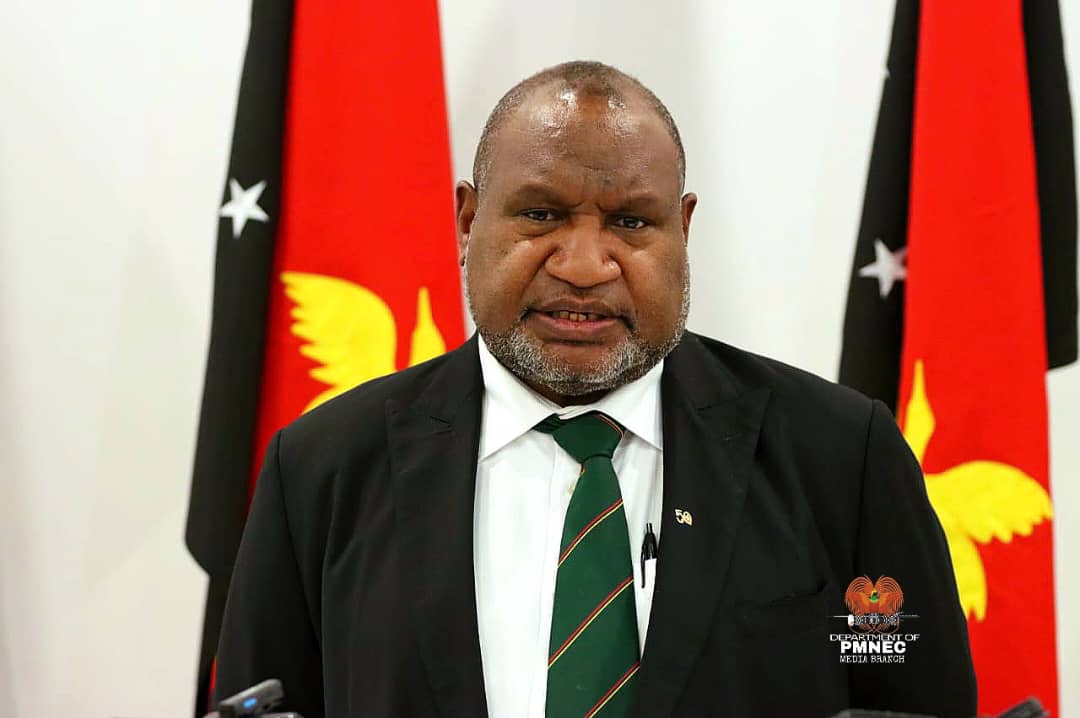

Prime Minister Hon. James Marape has completed a visit to some of the most remote and severely affected island communities in Milne Bay Province following the devastation caused by Category 5 Tropical Cyclone Maila, describing the experience as “deeply moving” and reaffirming the Government’s commitment to immediate relief and long-term recovery.
Prime Minister Marape travelled from Alotau to Misima, Rossel Island, Woodlark Island, and the easternmost atoll of Budi Budi—identified as the epicentre of the disaster—where communities endured up to eight days of continuous cyclone impact.
“Budi Budi is a small atoll with about 120 homes, a primary school, and around 450 people. To witness the extent of damage after eight days under a Category 5 cyclone was sobering,” Prime Minister Marape said.
“Yet what stood out most was not the destruction, but the resilience of our people—their strength, their smiles, and the way they welcomed us despite their hardship.”
The Prime Minister said his presence in the affected areas symbolised the support of the entire nation.
“I represent not just Milne Bay, but the whole country—our 21 provinces and Bougainville. I went there to assure our people that they are not alone. The full machinery of Government is being mobilised to deliver immediate relief and ongoing support.”
Prime Minister Marape confirmed that relief efforts are already underway, with provincial authorities, the Papua New Guinea Defence Force, and other agencies actively engaged in response operations.
“It was encouraging to see provincial government relief supplies already reaching affected communities, and our Defence Force personnel on the ground providing critical first-response support,” he said.
He also acknowledged the vital role played by humanitarian organisations, including the Red Cross and other non-government organisations, which have been working alongside government agencies to deliver emergency assistance and support to affected communities.
Cyclone Maila, one of the most powerful storms to hit Papua New Guinea, is estimated to have affected more than 300,000 people across Milne Bay and neighbouring regions, including parts of Bougainville, East New Britain, West New Britain, Morobe, and Oro provinces.The Prime Minister announced that a National Executive Council (NEC) meeting will be convened on Wednesday to formalise the Government’s disaster response strategy.
“We will address immediate relief requirements and also move into the next phase—long-term recovery and resilience-building,” he said.
“This includes developing permanent and semi-permanent housing with solar energy, clean water supply, and improved communication systems linking rural communities to district and national centres.”
Prime Minister Marape emphasised that the disaster underscores the urgent need to strengthen service delivery systems across Papua New Guinea’s predominantly rural population.
“Our country is 85 per cent rural. Whether in island, coastal, riverine or inland communities, our people must be supported by a government system that functions effectively from the national level down to the village,” he said.
“I was encouraged to see teachers, health workers, public servants, councillors, and churches continuing their work even in the face of disaster. This shows that our basic governance structures are functioning—but we must strengthen them further.”
The Prime Minister also acknowledged the support of international partners, noting the arrival of humanitarian supplies from Australia, New Zealand, the United Nations, and other partners into Alotau.
“We are working closely with our partners to ensure relief supplies are delivered directly to the people who need them most,” he said.
Looking ahead, Prime Minister Marape said the Government will incorporate disaster resilience into its medium-term development planning.
“Climate change, rising sea levels, and changing weather patterns are realities we must live with. Our development plans, including the upcoming MTDP5 and the revised MTDP4, will prioritise building resilient communities capable of withstanding future disasters.”
“Our focus is not only on recovery but on building systems and infrastructure that allow our people to live safely and sustainably in the face of these challenges.”
Prime Minister Marape reiterated that the Government remains fully committed to supporting all affected communities as they rebuild their lives.
“We will not leave our people behind. Together, we will recover, rebuild, and come back stronger.”