
Prime Minister Hon. James Marape says Education remains one of the proudest achievements of the Marape–Rosso Government over the past seven years.
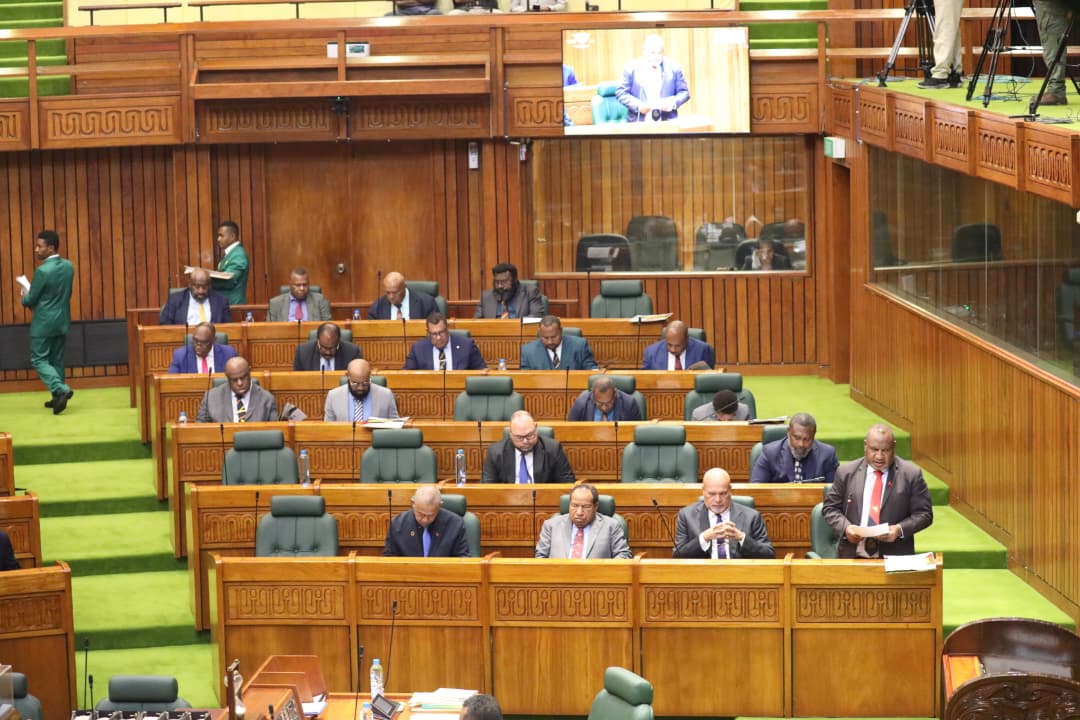
Presenting the Government’s 7-Year Performance Report in Parliament, Prime Minister Marape said Education was the most powerful investment any Government could make because it multiplies all other development interventions. “Education is the most powerful investment a Government can make. It is the multiplier of all other development interventions,” Prime Minister Marape said. He said an educated child becomes a healthier adult, a more productive worker, a more engaged citizen and a stronger foundation for national development.
The Prime Minister said the Government Free Education Programme had been the cornerstone of the Government’s Education commitment. Under the Programme, 2,565,713 students across Papua New Guinea have been enrolled in subsidized schooling, with K877 million in total disbursements. Annual Education Subsidy expenditure under the Government Tuition Fee Subsidy (GTFS) increased from approximately K602 million in 2019 to K1.01 billion in 2025. Total GTFS spending over the review period reached K4.6 billion. “No Papua New Guinean child should be denied an education because their family cannot afford school fees,” Prime Minister Marape said.
He said the Government had made historic investment to ease the burden on parents and keep children in classrooms. The Prime Minister also appealed to parents to play their part by supporting their children’s discipline, attendance, homework and character development. “Government paying school fees alone is not good enough. Parents must also take responsibility for their children’s education,” he said.
Prime Minister Marape said the Higher Education Loan Programme (HELP) had expanded access to Tertiary Education for students who may otherwise have missed out because of financial hardship. Under HELP, 53,958 students have been supported through subsidised education loans, with total disbursements of K284.7 million. “HELP ensures that a bright young Papua New Guinean from a remote Province does not have to abandon university aspirations because of financial circumstances,” he said. “We are investing in the next generation of doctors, engineers, teachers, lawyers and leaders.”
The Prime Minister said Technical and Vocational Education and Training (TVET) institutions had also received sustained support to expand enrolment and improve skills training. He said the Government was working to align TVET programmes with labour market demand in construction, agriculture, ICT, health, and the extractive sectors.
School classrooms, laboratories, libraries and teacher housing have been constructed and rehabilitated across Provinces and Districts, while DSIP and PSIP funding has supported school improvements at community level. Prime Minister Marape said teachers remained the backbone of the education system, and the Government had addressed salary arrears, invested in teacher training and supported accommodation and working conditions for teachers in remote areas.
The Prime Minister also highlighted the Government’s focus on young people, noting that 42 percent of PNG’s population of 10,185,363 people are below 18 years of age. He said the National Youth Engagement Strategy 2025–2029 had been backed with K100 million in dedicated funding, while the Permanent Parliamentary Committee on Youths and Children was established in May 2025 to provide sustained Parliamentary oversight of Youth Policy.
Prime Minister Marape said more than 3,000 Papua New Guineans had accessed overseas employment opportunities through the Pacific Australia Labour Mobility Scheme, gaining skills and remittances that benefit families and communities. “Our children and young people are not statistics. They are the future of this country,” he said. “The Marape–Rosso Government will continue to invest in Education from early learning to primary, secondary, TVET and university, because the best way to build Papua New Guinea is to build its people.”