
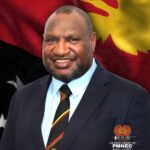

Prime Minister Hon. James Marape on Monday rejected internal Treasury projections circulating in the public space that claim the revised fiscal arrangements for the Papua LNG project will cause a K28 billion revenue deficit by 2035.
Speaking ahead of the project’s Final Investment Decision (FID) deadline on December 15, 2026, Prime Minister Marape stated that the government has not compromised its long-term financial position and that the local economy will instead expand through a combined K70 billion capital investment program.
He emphasized that this includes the project’s US$14.5 billion capital expenditure, valued at about K60 billion under baseline financial modelling.
PM Marape further clarified that Papua LNG represents the initial step in a broader economic roadmap designed to expand total sector activity through sequential resource developments.
Prime Minister Marape confirmed he has directed the Department of Treasury to reconcile its data with the State Negotiating Team (SNT) during a scheduled meeting on Monday.
He noted that while the petroleum tax from the existing PNG LNG project may experience a temporary decline due to accelerated depreciation schedules, the revenue will be fully recovered once Papua LNG enters production.
He also emphasized that the multi-billion-kina construction phase starting in 2027 will immediately broaden the national tax base via goods and services tax (GST), corporate income tax (CIT), and personal income tax (PIT).
“I want to say from the outset – and someone can hold me to my words – that in 2029, there will not be a drop in PNG government revenue,” Prime Minister Marape promised. “We don’t see it just from the lenses of five-year revenue loss. We look at it from the context of intergenerational benefit and value chain to the economy.”
According to State Negotiating Team (SNT) briefings, the Treasury analysis inaccurately categorizes temporary timing deferrals and State equity financing as permanent financial losses.
The SNT calculated the true advanced depreciation timing shift at approximately K4.6 billion to K5 billion between 2029 and 2032, contrasting sharply with Treasury’s K16.9 billion estimate.
Furthermore, the US$1.95 billion fiscal concession is not an unconditional bonus but a price-pegged mechanism balanced by matching structural premiums that trigger when global oil prices rise.
“Investors like Exxon and Total are global investors,” Prime Minister Marape stated, explaining the need to remain competitive against rival projects like Mozambique’s 80 trillion cubic feet (TCF) field.
“The difference this time around is concessions are not free. We have pegged these concessions to price. They make the recovery at prices below $81. We make our recovery at prices above $83.”
Prime Minister Marape explained that the administration is targeting long-term sector stability by strategically planning consecutive infrastructure developments to maintain continuity.
“With Papua, P’nyang, Muruk, and potentially Wildebeest projects, we want to sequence 15 to 20 years of construction sector in the LNG industry,” Prime Minister Marape stated. “After Papua is complete, we want to go into P’nyang and Muruk constructions, and then we want to bring in Wildebeest at the back end. That should give our country up to 20 years of construction dollars.”
According to the updated administration projections, this phased multi-project pipeline represents a cumulative foreign direct investment potential estimated at approximately $40 billion, managed by the consortium led by ExxonMobil.
The strategy shifts the country’s resource outlook from standalone timelines to an estimated 50 years of continuous liquefied natural gas production.
“The State Negotiating Team and the Prime Minister’s Department will extrapolate the modelling that runs beyond Papua into P’nyang, Muruk and Wildebeest, going forward into the next 30, 40, 50 years,” Prime Minister Marape added.
“Learning from past experience, we don’t want Papua to be a one-hit wonder. By bringing Papua, P’nyang, Muruk, and Wildebeest, we’re looking at putting LNG production into 50 years of Papua New Guinea being a strong LNG-producing nation.”
The Prime Minister assured provincial governments and project landowners that their specific equities, levies, and royalties remain completely unaffected by the negotiated fiscal terms.
Under the final structure, landowners stand to receive improved royalty calculations due to the removal of capital cost deductions, alongside free power provisions in designated upstream and downstream zones.
“Papua LNG – just like New Porgera and other James Marape-led negotiated projects will always gain above 55 percent of total project economic value for the country,” he added.
The integration of Papua LNG and PNG LNG will create a combined 17 TCF resource, boosting total production capacity past 12 million tons per annum by 2033.
“This work we are doing is for earnings for our country 10, 15, 20 years from today,” PM Marape reassured.
“And I want to put my name behind this assertion – that there is no revenue loss starting 2029 onwards. It’s all an aggregate gain for the country going forward.”