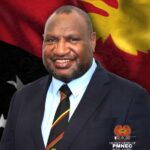
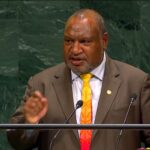

Prime Minister Hon. James Marape has invited leading French investors, financiers, infrastructure companies, and technology firms to partner Papua New Guinea as the country enters a new era of economic growth driven by energy, infrastructure, industrial development, and regional connectivity.
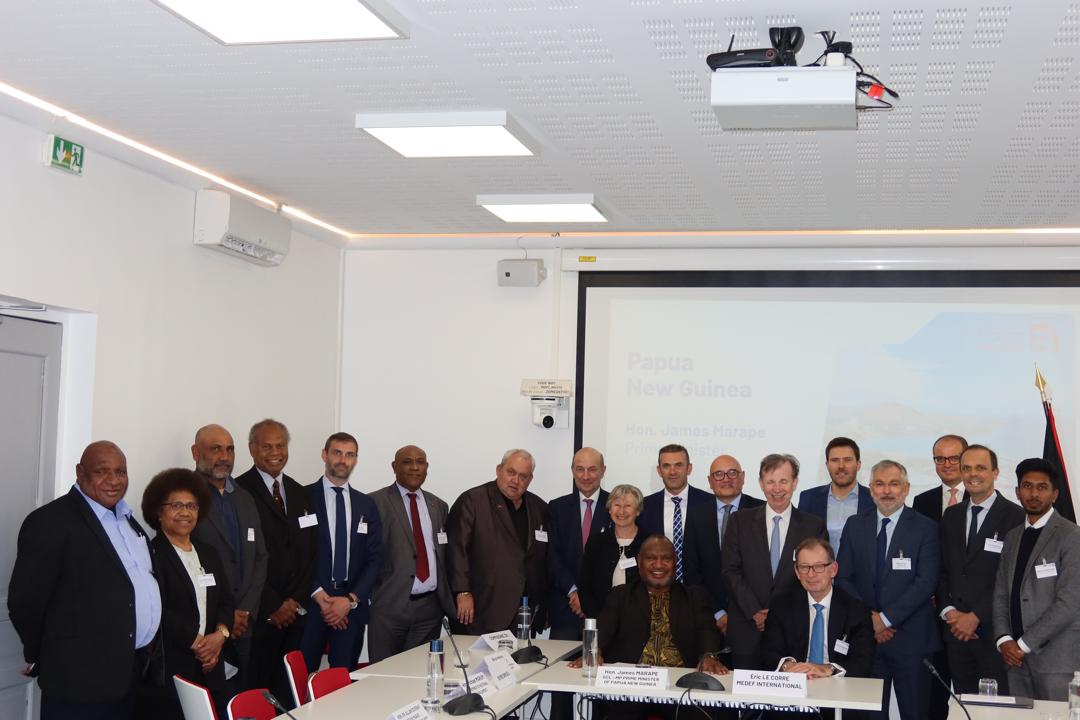
Prime Minister Marape made the call during a high-level meeting hosted by MEDEF International in Paris as part of his official visit to France.
The meeting brought together representatives of major French companies and investors operating across the energy, finance, infrastructure, utilities, telecommunications, aviation logistics, healthcare, and industrial sectors.
Companies represented included Global Sovereign Advisory, Matière, Veolia, BPCE, Flying Whales and international telecommunications company iBASIS.
Prime Minister Marape said Papua New Guinea, now celebrating its 50th anniversary of Independence, was positioning itself for the next phase of national economic transformation and international partnerships.
“The next 20 years for Papua New Guinea will be about building roads, roads, roads and bridges,” Prime Minister Marape said. “We have major rivers, difficult terrain, and enormous infrastructure needs.We are open to innovative financing and strong private-sector partnerships.”
The Prime Minister said Papua New Guinea was returning to a balanced budget next year for the first time since 2010, positioning the country for stronger investor confidence and disciplined long-term economic management.
During discussions on the Papua LNG project, Prime Minister Marape said the project represented one of the largest investment opportunities in Papua New Guinea’s history.
“The Papua LNG project is expected to generate tens of billions of US dollars in investment and economic activity over its lifetime,” he said.
“Papua New Guinea and national stakeholders will need to finance participation in the project, so we are already exploring options for raising funds — either independently or through partnerships.”
Prime Minister Marape reflected on the PNG LNG project, noting that when the project commenced in 2008 the State held no equity participation, whereas PNG parties now collectively held approximately 19.57 percent state equity.
“The PNG LNG project is now stable and no longer carries major loan obligations,” he said. “It is becoming a premium project for us. At the back of that balance sheet, I am confident the State has the ability to participate, especially if financing can be secured at near-concessional rates.”
Prime Minister Marape also updated investors on ongoing discussions with French energy giant TotalEnergies and project partners regarding the Papua LNG Final Investment Decision.
He said while the gas agreement signed in 2019 remained unchanged, global economic conditions had changed significantly following COVID-19, the Ukraine conflict, and instability in the Middle East.
Prime Minister Marape said earlier project estimates of around US$18 billion had now been revised closer to US$14 billion following rebidding processes and cost optimisation discussions.
“We are negotiating through a tight space,” he said.“I am saying I can provide some incentives, but it will not be a free gift. The State must also benefit from the upside when prices rise.”
The Prime Minister said Papua New Guinea’s gas development pipeline extended well beyond Papua LNG.
“Besides Papua LNG, we also have the P’nyang project and about three other projects lined up,” he said.
“As far as gas construction activity is concerned, PNG could see continuous activity running right through to 2040.”
Prime Minister Marape also welcomed discussions on innovative financing models, including debt-for-nature and debt-for-climate swaps, saying Papua New Guinea’s globally significant forests and oceans positioned the country strongly for future climate-linked financing opportunities.
French bridge engineering company Matière outlined its ongoing involvement in Papua New Guinea since 2010, including the construction of more than 20 bridges supporting PNG LNG infrastructure and participation in the Government’s Connect PNG programme.
The company presented plans for more than 55 bridge sites across Papua New Guinea, including projects in Kerema, Wapenamanda, Middle Ramu, Bougainville, Bulolo, Rigo, and Port Moresby.
Prime Minister Marape challenged the company to consider establishing bridge manufacturing operations inside Papua New Guinea.
“If I give you clean hydro energy and reliable power, can you relocate bridge manufacturing to PNG?” he asked.
He said Papua New Guinea’s strategic location and links to ASEAN, APEC, and Pacific regional markets positioned the country as a future industrial and export hub.
“If you relocate manufacturing to PNG, we may give you all the bridges we need to build,” he said. “And not just PNG — you could export to Southeast Asia and the Pacific.”
Discussions also covered water, waste management, and utility infrastructure with Veolia.
Prime Minister Marape said Papua New Guinea’s growing middle class and increasing urbanisation were creating urgent demand for modern utility services across the country.
“We are interested in PPP models where private partners finance and build infrastructure and the State repays over time,” he said.
Representatives from infrastructure financing group Elis Projects also discussed possible financing arrangements to revive the stalled Kimbe General Hospital project.
Prime Minister Marape reaffirmed the Government’s commitment to modernising PNG’s health infrastructure.
“Kimbe Hospital remains a priority project,” he said. “We need modern hospitals across PNG. If financing below three percent with a reasonable grace period can be arranged, I am interested.”
Representatives from French banking group BPCE also expressed interest in expanding operations into Papua New Guinea.
Prime Minister Marape said Papua New Guinea remained the dominant economy in the Pacific and offered substantial opportunities for banking growth.
“There is room for more banks in PNG,” he said. “You can enter directly or partner with existing banks such as TISA Bank.”
The meeting also explored emerging aviation logistics technologies, with Flying Whales presenting its proposed heavy-lift airship technology capable of transporting cargo into remote areas without roads or airport infrastructure.
Prime Minister Marape said Papua New Guinea’s geography made aviation a critical component of national development.
“PNG remains heavily dependent on aviation because of our terrain and limited roads,” he said.“There is definitely space for this technology.”
Telecommunications and digital connectivity also featured strongly in discussions, with Prime Minister Marape reaffirming Papua New Guinea’s commitment to expanding nationwide connectivity through technologies such as Starlink and other satellite and digital systems.
“Telecommunications are critical for future economic growth and governance,” he said. “PNG is open for business.”
In his closing remarks, Prime Minister Marape announced Papua New Guinea’s intention to establish a diplomatic presence in France.
“France deserves a Papua New Guinea embassy in Paris,” he said. “France has maintained an embassy in Port Moresby for many years and Papua New Guinea must reciprocate. We are opening that diplomatic presence soon. Papua New Guinea remains one of the world’s last great frontier economies — rich in resources, strategic in location, and full of opportunity. We are open for business. Come to Papua New Guinea.
“Let us grow together.”