
Prime Minister Hon. James Marape today declared the newly upgraded Gurney Airport the gateway to Papua New Guinea’s tourism future, announcing plans to pursue direct international flights into Milne Bay as part of a broader strategy to transform the province into the country’s premier tourism destination.
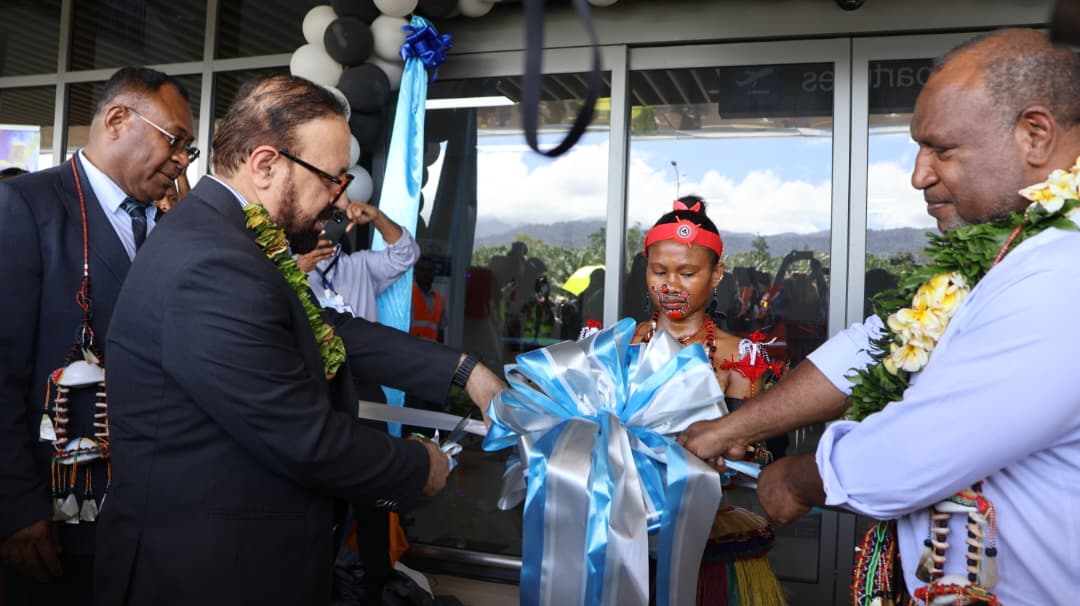
Speaking at the official opening of the upgraded airport, Prime Minister Marape said the K76.8 million investment was about far more than aviation infrastructure—it was about creating jobs, growing local businesses and unlocking the enormous tourism potential of Milne Bay.
“This airport is an investment in our people and in the future of our economy,” Prime Minister Marape said.
“I want Gurney Airport to become Papua New Guinea’s first dedicated tourism airport, bringing international visitors directly into one of the most beautiful and culturally diverse provinces in our nation.”
The Prime Minister said the completion of Gurney Airport marked a major milestone under the Civil Aviation Development Investment Programme Phase II (CADIP II), describing it as one of the Pangu-led Government’s signature national infrastructure programmes.
“I am pleased that since we launched this project here on 24 May 2024, Gurney Airport has now been completed and officially opened,” he said.
“CADIP II is transforming aviation infrastructure across Papua New Guinea. Alongside Gurney, major airport upgrades are progressing at Aropa, Wewak, Kiunga and Hoskins, while rural airstrips such as Palmalmal are also being upgraded. The programme is also investing in aviation safety systems, weather services, navigation equipment and other critical infrastructure that will make flying safer and more reliable throughout our country.”
Prime Minister Marape announced that the Government would now work with the National Airports Corporation, Civil Aviation Safety Authority, Immigration, Customs and other aviation agencies to prepare Gurney Airport for international operations.
He said the long-term objective was to establish direct flights from Brisbane, allowing visitors to combine air travel with cruise tourism through the Milne Bay islands.
“We want tourists to fly directly into Milne Bay, experience our spectacular islands, culture and marine environment, then travel through the province and on to Port Moresby, or vice versa. This is the tourism corridor we are building.”
Prime Minister Marape said Milne Bay possessed all the ingredients necessary to become a world-class tourism destination.
“Australia sends millions of tourists overseas every year. Milne Bay alone has 38 distinct cultures, world- renowned diving, beautiful islands, rich history and some of the friendliest people anywhere in the Pacific.
“Our greatest resource is not gold or timber—it is our people, our culture and our natural environment.”
The Prime Minister encouraged customary landowners to register their land, retain ownership and develop locally owned tourism businesses instead of selling customary land.
“I do not want our people selling their land. Register it, keep ownership, and use it to build guest houses, eco- lodges and tourism enterprises.
“Working with the National Development Bank, we want local people to access finance and become tourism entrepreneurs, ensuring tourism income stays with local communities.”
Prime Minister Marape said international visitors spend thousands of dollars during their stay, creating enormous opportunities for local businesses, accommodation providers, transport operators, cultural groups and artisans.
“If Milne Bay attracts just 20,000 visitors annually, the economic benefits flowing into this province will be substantial. That is why we are investing in infrastructure first—to create opportunities for our people.”
The Prime Minister also reaffirmed his Government’s commitment to completing the road linking Port Moresby to Alotau, creating a continuous tourism corridor from Central Province through to East Cape.
He said visitors would eventually be able to fly into Port Moresby, drive through the scenic coastal corridor to Milne Bay and depart internationally from Gurney Airport—or arrive in Alotau and travel in the opposite direction.
“This is long-term planning for the next 50 years of Papua New Guinea.”
Prime Minister Marape praised the Asian Development Bank (ADB) for its decades-long partnership with Papua New Guinea, describing it as one of the country’s most reliable development partners.
“ADB stood with Papua New Guinea during some of our most difficult economic periods and continues to support transformational investments like this.
“This airport was financed through highly concessional lending because borrowing responsibly to build productive economic infrastructure is an investment—not a liability.”
Prime Minister Marape commended the National Airports Corporation, the Civil Aviation Ministry, the Civil Aviation Safety Authority, the National Weather Service, other aviation agencies and China Railway Construction Engineering Group for successfully delivering the project.
Calling on Milne Bay residents to protect law and order and preserve the province’s reputation, Prime Minister Marape said tourism would only flourish in a peaceful and welcoming environment.
“I cannot create every job directly, but Government can create the conditions for jobs to grow.
“This airport is one of those conditions.
“I ask the people of Milne Bay to take ownership of your future, protect your province, preserve your culture and work together so that tourism becomes a lasting source of prosperity for generations to come.”
Prime Minister Marape concluded by expressing his hope of travelling on the first international flight to land at Gurney Airport.
“I look forward to returning on that first international service. Together, we are opening a new chapter for Milne Bay and for Papua New Guinea’s tourism industry.”