
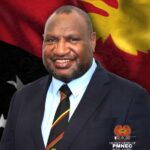

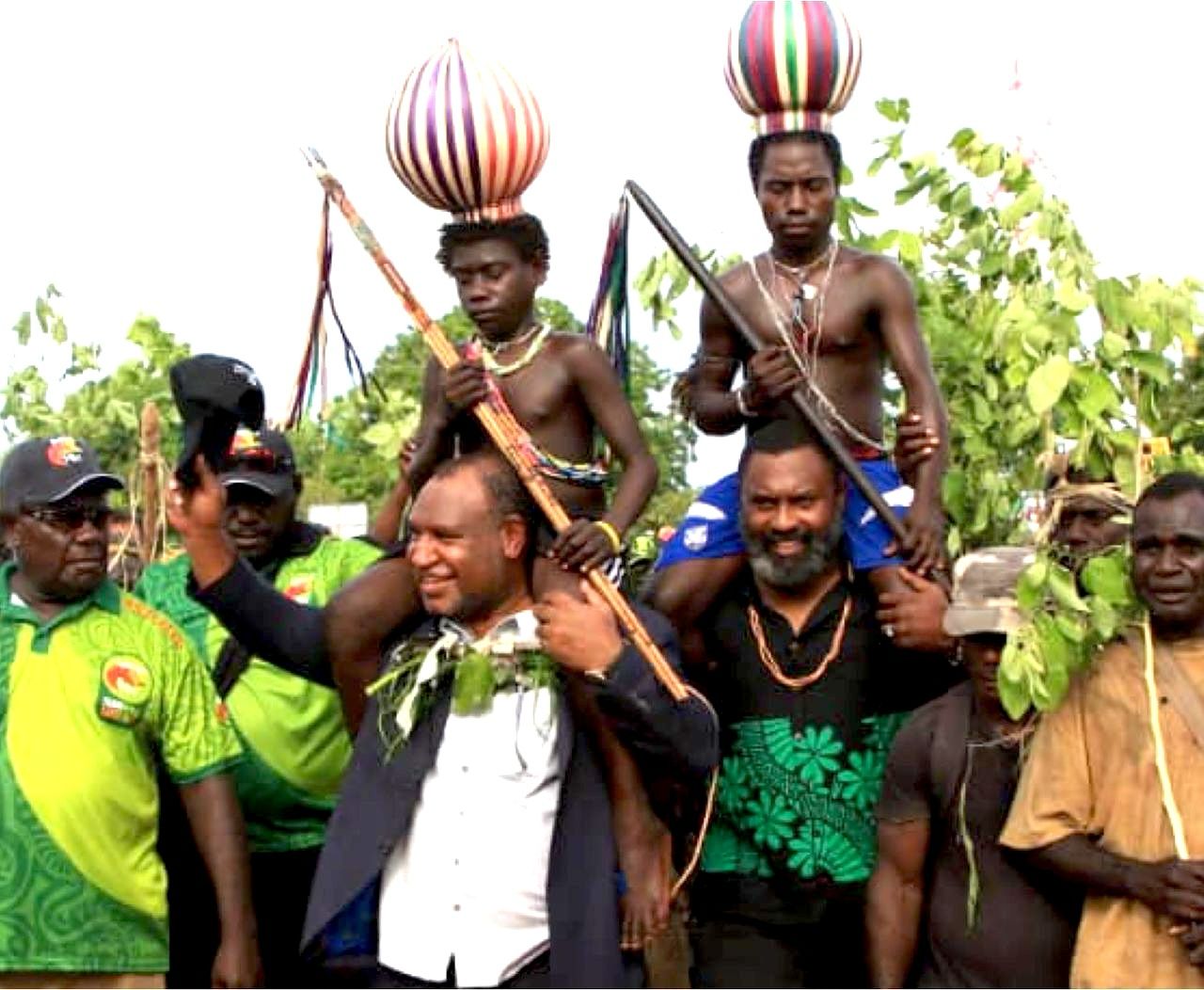

Prime Minister Hon. James Marape has emphasised that the future political status of Bougainville can only be determined through the constitutional process set out in Part XIV of the Papua New Guinea Constitution.
Prime Minister Marape said the Bougainville Peace Agreement of 2001, which was negotiated and agreed by all parties to end the conflict, was subsequently incorporated into Part XIV of the Constitution and provides the legal framework governing relations between Papua New Guinea and Bougainville.
“The constitutional pathway for Bougainville’s political future is clearly established in Part XIV of our Constitution,” Prime Minister Marape said.
“Within that framework, Section 342(2) expressly provides that the National Parliament must make the final decision on the outcome of the Bougainville Referendum.
“This provision was not created by my Government. It was agreed to and promulgated in 2001 as part of the Bougainville Peace Agreement. Many of the leaders involved in those negotiations, including current Bougainville leaders, understood and accepted that the National Parliament would ultimately make the decision after a referendum was held.”
Prime Minister Marape noted that while a number of mandatory requirements under Section 338 of the Constitution, including the complete surrender of weapons, good governance benchmarks and other conditions associated with the peace process, had not been fully met, his Government nevertheless allowed the Bougainville Referendum to proceed in 2019 based on recommendations from the United Nations and in the interest of preserving the integrity of the peace process.
“I allowed the referendum to take place under my watch despite some of the mandatory requirements not being fully met because we respected the peace process, the recommendations of the United Nations, and the constitutional pathway agreed to by all parties,” Prime Minister Marape said.
“I did so knowing that Part XIV of the Constitution, particularly Section 342(2), provides the constitutional safeguard that the National Parliament would ultimately consider and decide on the referendum outcome.”
The Prime Minister said the referendum was never intended to be the final step in the process.
“The referendum was not the end of the process. It was designed to ascertain the views of the people of Bougainville and provide guidance for the next stage of constitutional decision-making.”
The Prime Minister said the referendum process and the parliamentary decision-making process are distinct constitutional processes, each with its own purpose, authority and procedures under Part XIV of the Constitution.
“The referendum was conducted to ascertain the views of the people of Bougainville on their political future. Parliament’s role is different. Section 342(2) of the Constitution expressly requires Parliament to consider the referendum outcome and make a decision through its own constitutional processes.
“Parliament is not the National Government. Parliament has its own mind, its own procedures and its own constitutional responsibilities. The National Government may hold a position on the matter, but Parliament is the embodiment of the people’s representation from across Papua New Guinea, including Bougainville. It must be allowed to deliberate and reach its own decision in accordance with the Constitution.
“Both the referendum process and the parliamentary process were provided for under the Bougainville Peace Agreement and subsequently incorporated into the Constitution. One does not replace the other. Respect for the referendum also requires respect for Parliament and the constitutional role assigned to it.”
The Prime Minister said no one should seek to pre-empt the judgment of Parliament.
“Whether Parliament ultimately votes yes or no is a matter for Parliament itself. No one can predetermine the outcome or pre-empt the collective wisdom of the House.”
Prime Minister Marape said the decision to alter the territorial integrity of Papua New Guinea was the most serious responsibility entrusted to the National Parliament and must be approached with the highest constitutional threshold.
“Breaking up a country is the most serious decision any parliament can make. It is only proper that a super-majority befitting a constitutional change should determine such a matter. No individual leader, no government and no region can unilaterally make that decision. It must be made collectively through Parliament in accordance with the Constitution.”
Prime Minister Marape said he would continue to engage constructively with Bougainville leaders while maintaining the National Government’s position that the constitutional process must be respected.
“When I meet Bougainville leaders, I will maintain the National Government’s position that they must respect the parliamentary process that is currently underway. I will ask them to agree on a date for Parliament to consider the referendum outcome. I have previously proposed 30 August this year, subject to the agreement of the Autonomous Bougainville Government.”
The Prime Minister said the Speaker’s position that a three-quarter majority of Parliament should decide the matter was consistent with the constitutional significance of the issue.
“The Speaker’s interpretation is in order because the Bougainville referendum process is anchored in constitutional law. The relevant provisions are contained within our Constitution and nowhere else.”
The Prime Minister outlined the position adopted by PANGU Pati should Parliament vote in favour of independence.
“If Parliament votes yes, we believe Section 342(1) provides a pathway for a negotiated transition period of up to 15 years during which powers can progressively be drawn down from the National Government to Bougainville.”
He said such a transition would include the transfer of additional powers and responsibilities and would be subject to agreed conditions.
“Those conditions would include Bougainville generating sufficient internal revenue to sustain at least 70 per cent of its annual budget based on a rolling five-year average, maintaining peace and stability, ensuring gun-related violence, armed factions and warlordism are no longer prevalent, and meeting other conditions agreed by both governments.”
Prime Minister Marape said that upon successful completion of the transition period and fulfilment of agreed conditions, Parliament could then consider amendments to Section 2 of the Constitution and other consequential amendments necessary to give full effect to independence. He said if Parliament votes against independence at this stage, the referendum result should remain alive rather than being discarded.
“If Parliament votes no, the referendum result should not be extinguished. It should remain alive while Bougainville is given the same 15-year period to satisfy agreed conditions and demonstrate readiness for nationhood.
“At the end of that period, Parliament could again be presented with the referendum result and make a decision based on the circumstances existing at that time.”
Prime Minister Marape said this was the context behind his recent remarks that ‘a yes can become a no and a no can become a yes’.
“What I meant was that the issue will not be finally resolved by a single vote alone. The parliamentary vote simply begins the next stage of our collective journey as a nation.”
He said Section 342(1) provides a constitutional bridge for both governments to continue to “walk together and work together”.
“Time is a healer. Some realities become clearer as time passes and through practical experience. The Constitution provides a pathway that allows both sides to continue engaging constructively.”
Prime Minister Marape said he had deliberately maintained a low profile on the issue out of respect for the constitutional processes currently underway.
“However, I want to assure all Papua New Guineans that Part XIV of the Constitution and the constitutional authority of Parliament will always be defended by me because the Prime Minister must be the last person standing in defence of our nation’s Constitution.
“For Bougainville, there is no path to nationhood outside the constitutional process. There is no other way except through Part XIV of the Constitution, including the parliamentary process prescribed under Section 342(2).”
The Prime Minister said the constitutional process governing Bougainville’s future was well understood by the international community.
“The United Nations knows it. The five permanent members of the United Nations Security Council know it. The Pacific Islands Forum knows it. The Melanesian Spearhead Group knows it. The Commonwealth knows it.
“They all understand that Bougainville’s political future must proceed through the constitutional process agreed under the Bougainville Peace Agreement and enshrined in Part XIV of the Constitution.”
Prime Minister Marape said Papua New Guinea had already granted Bougainville substantial autonomy and remained open to discussions on additional powers.
“We have come a long way since Independence in 1975 and since the Bougainville Peace Agreement in 2001. We have honoured our commitments and granted Bougainville more powers than any other province under Section 290 of the Constitution. We remain open to discussing additional powers available under Section 289, but the constitutional process must be respected.”
Prime Minister Marae concluded by reminding all parties that Papua New Guinea’s unity was founded on extraordinary diversity.
“We are a nation of immense diversity brought together as one sovereign country on 16 September 1975.
“To untangle that union is serious business. No one person can decide such a matter. It can only be determined through the constitutional decision-making process of Parliament acting on behalf of all the people of Papua New Guinea.”