

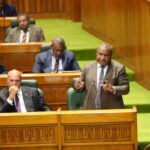
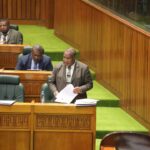
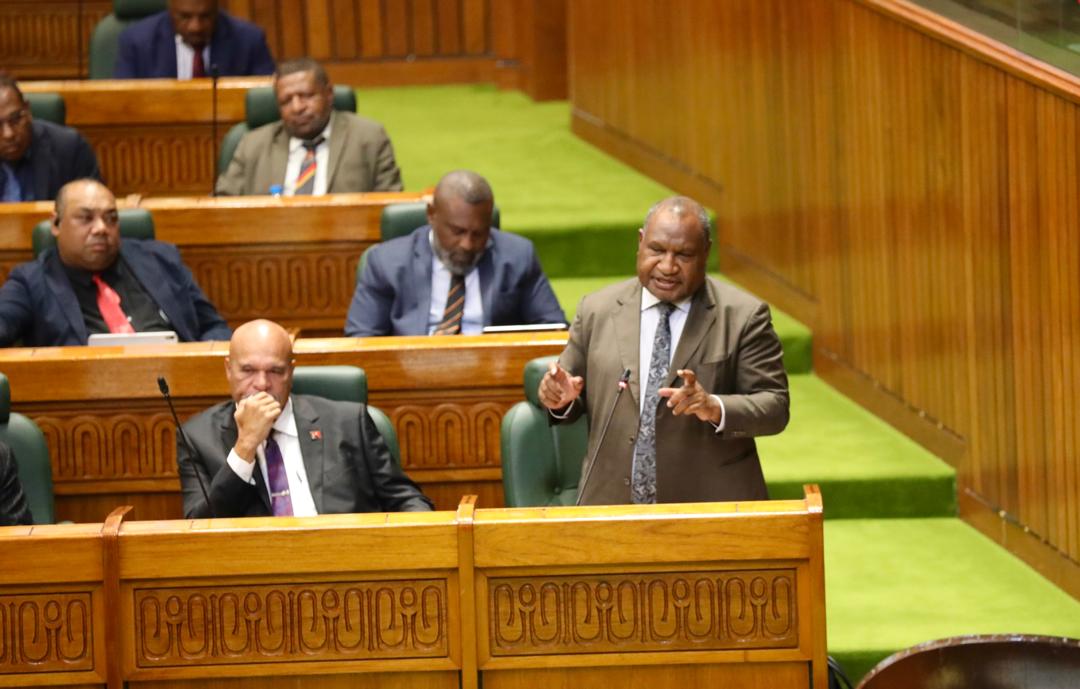

Prime Minister Hon. James Marape has defended the Government’s reforms to the functions of Treasury, Finance and National Planning, assuring Parliament that efforts to exit the Financial Action Task Force (FATF) grey list will remain uninterrupted, while reaffirming plans to deliver a balanced National Budget in 2027.
Responding to questions without notice from Opposition Leader Hon. James Nomane in Parliament today, Prime Minister Marape said the reforms were aimed at eliminating overlapping responsibilities, strengthening accountability and allowing Treasury to concentrate on economic growth and revenue generation.
Mr Nomane questioned the transfer of warranting responsibilities from Treasury to Finance, citing International Monetary Fund (IMF) concerns about expenditure controls and financial accountability. He also raised concerns about Papua New Guinea’s FATF grey listing and its relationship with international creditors.
Prime Minister Marape acknowledged the concerns but said the three economic departments had become too heavily involved in cash distribution rather than their core responsibilities.
“Three big departments are all preoccupied with cash distribution. Someone must be focused on income,” he said.
Under the Government’s reforms, Treasury is responsible for economic growth and revenue generation, Finance handles expenditure and cash management, while National Planning concentrates on long-term development priorities.
Treasury retains oversight through weekly Budget Management Committee meetings, while warranting and cash flow management are assigned to Finance.
The Prime Minister said National Planning should no longer be directly involved in processing Public Investment Programme (PIP) payments, with approved funds going through responsible departments, provinces, districts and statutory bodies.
He said overlapping responsibilities had persisted through successive National Alliance, People’s National Congress and Pangu Pati-led governments.
“This problem has been around for some time. These three big departments clearly overlap. We need to fix this once and for all,” he said.
Prime Minister Marape acknowledged the IMF’s position that Treasury should retain warranting authority to maintain checks and balances, but maintained that the Government’s reforms would establish clearer accountability.
He said the reallocation of responsibilities was consistent with the Government’s interpretation of the Public Finances (Management) Act, while legislative amendments and stakeholder consultations were continuing to support the arrangements.
“I stand to be corrected if someone from Treasury, the Opposition, academia or anyone else feels that warranting should remain with Treasury,” he said.
Addressing concerns about FATF grey listing, Prime Minister Marape assured Parliament that compliance work involving the Bank of Papua New Guinea, Treasury, the Justice Department and other relevant agencies would continue.
“I want to give assurance that the grey listing work will remain unimpeded. It is running,” he said.
He said Papua New Guinea had previously exited grey listing in 2016 and the Government remained committed to achieving the same outcome.
On the economy, Prime Minister Marape said the Government intended to avoid new borrowing from the IMF and other lenders in 2027, subject to global economic conditions.
“IMF knows very well that next year we are not borrowing from them or borrowing from anyone,” he said. He credited the Treasurer’s fiscal consolidation programme for reducing the budget deficit from 8.9 per cent of gross domestic product in 2020, during COVID-19, to approximately 1 per cent under the latest Supplementary Budget.
Prime Minister Marape said the Government had prioritised concessional financing from international development partners, generally at interest rates below 3 per cent, instead of more expensive commercial borrowing.
He contrasted this with the US$500 million sovereign bond issued in 2018 at 8.375 per cent interest, with principal repayment due in 2028.
Looking ahead, Prime Minister Marape reaffirmed the Government’s target of delivering the country’s first balanced National Budget since 2010.
“Next year, we’ll hand down our first balanced budget,” he said.
He acknowledged that global economic uncertainties, particularly conflicts affecting oil-producing regions, could influence the country’s fiscal outlook.
“We hope that in the 2027 Budget, we deliver the first balanced budget in as many years since 2010,” Prime Minister Marape said.
He maintained that the reforms would strengthen financial accountability, improve expenditure management and allow the three economic departments to better serve Papua New Guinea’s long-term development.