
An elderly woman standing beside the road high in the mountains was in tears when Prime Minister Hon. James Marape stopped to speak with her during his historic overland journey from Port Moresby to Lae. The Prime Minister offered her some money. She refused.
“She said to me, ‘Please son, just pass through. I am happy for the road,’” Prime Minister Marape recalled after arriving in Lae early this morning.“She did not want money. She was simply happy for the road. That really touched my heart.”
For Prime Minister Marape, the encounter captured the deeper meaning of the journey — taking roads, economic opportunities and essential services to Papua New Guineans who have lived for generations in some of the country’s most isolated communities.
“As a child of rural PNG myself, this was one of the most satisfying moments for me,” he said.“These are our people. They may live far away from our towns and cities, but they are Papua New Guineans. They have dignity. Every Independence anniversary they raise our country’s flag and sing our national anthem.
“The question I ask is: Do we just leave them behind?“My answer is no. They deserve the love and care of their Government.”
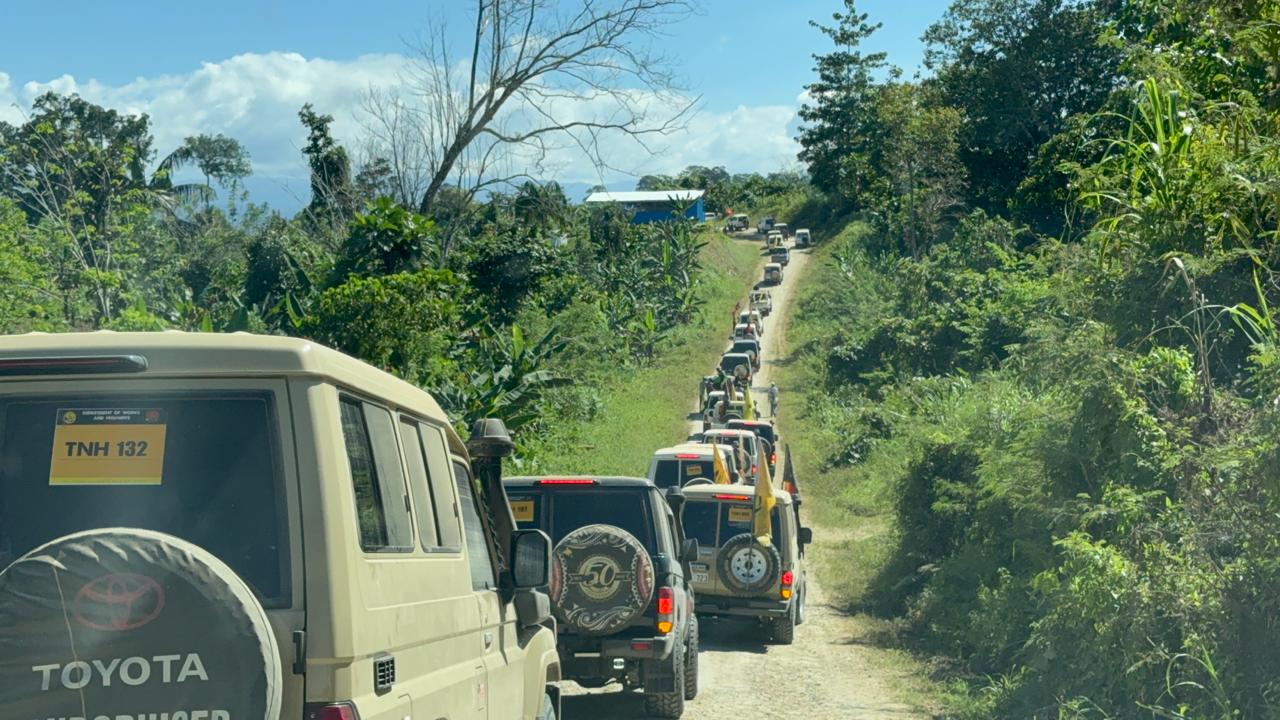
Prime Minister Marape arrived in Lae early this morning after completing the historic overland journey from Port Moresby through Central, Gulf and Morobe provinces.
With Papua New Guinea’s 51st Independence Anniversary just days away, he described the journey as a statement of the Government’s intent for the country’s next 50 years.
“This drive before our 51st Independence Anniversary is a statement of intent,” he said. “As we move beyond our first 50 years, we must bring all our people with us. It does not matter how remote they are. We will still go to where they are.”
MORE THAN 200 STOPS — AND THE WARMTH OF RURAL PNG
Prime Minister Marape said the journey became as much about meeting people as it was about demonstrating the road connection.
He estimated that he stopped more than 200 times along the way as families, farmers, children and elderly people gathered beside the road to greet him and the travelling party.
“From Bereina onwards, I saw the love, warmth and sincerity on the faces of our people, from the young to the old,” he said.“At one place, a young couple and their family came out and freely gave me a coconut as I was passing through.These are simple gestures, but they say so much about the generosity and warmth of our people.”
The Prime Minister said encounters such as these reinforced his belief that national development must reach Papua New Guineans living beyond the country’s established urban centres.
NOT YET A SUPERHIGHWAY
Prime Minister Marape stressed that the Port Moresby–Lae connection should not be mistaken for a completed modern highway.
“I am the first to say this is not a superhighway as yet,” he said.This is a first-cut road through virgin forests, rugged mountains, high mountain valleys, lowland plains, rivers and wetlands. But we have demonstrated that the connection is possible. Now we must progressively improve it into an economic highway that will serve our people for generations.”
Prime Minister Marape estimated that bringing the corridor to full highway standard could require between K3 billion and K5 billion over the next five to 10 years.
He said such expenditure must be viewed as a long-term national investment rather than simply the cost of constructing a road.
“This is the sort of investment we must make to deliver infrastructure that will be useful to our economy in the long run,” he said.
TAKING COFFEE FROM THE MOUNTAINS TO MARKET
Prime Minister Marape rejected suggestions that the road was of little economic value, saying the journey demonstrated the enormous agricultural potential of the communities it connects.
Coffee bags were already visible along sections of the route.
“This is not waste. This is productive investment,” he said.
Prime Minister Marape challenged coffee-growing communities around Kaintiba, Kotidanga and Menyamya, including the hardworking Anga people, to take advantage of the new road connection.
“I am challenging our people on both sides to work towards producing 100,000 bags of coffee a year from each side and use this road to take that coffee to market,” he said.“The Anga people are renowned for hard work and coffee. Yesterday, we could already see coffee bags along the way.”
He said improved road access would help farmers move coffee and other agricultural produce to markets while making it easier for essential services to reach isolated communities.
“This road is for our farmers. It is for teachers serving remote schools. It is for health workers, churches, community police and our people,” Prime Minister Marape said. “It is about bringing services in and bringing our people’s produce out to the markets.”
CONNECT PNG IS ABOUT PEOPLE
Prime Minister Marape said the historic journey demonstrated that Connect PNG was about much more than building roads.
It was about connecting farmers to markets, children to schools, communities to health services and isolated populations
to economic opportunities. “Our roads must become economic lifelines,” he said.“They must open up agriculture, tourism, trade and business and allow our people to participate fully in the economy.”
The Prime Minister said the same national commitment applied to Papua New Guinea’s island and coastal communities, where appropriate transport solutions were also needed to overcome geographical isolation.
“This is about our highlands communities, our coastal communities and our island communities. Every Papua New Guinean must be part of our development journey,” he said.
FROM EAST CAPE TO WUTUNG
Prime Minister Marape said the Port Moresby–Lae connection formed part of the much larger Connect PNG vision to progressively link the country’s previously disconnected regions and productive economic areas.
“We want, in the not-too-distant future, a Papua New Guinea where you can drive from East Cape in Milne Bay to Wutung in West Sepik, with road arteries crisscrossing our country and opening up its full economic potential,” he said.
“We want these roads to become tourism routes, economic lifelines and economic arteries.They must unlock agriculture, tourism, trade and business.”
Prime Minister Marape acknowledged that building such a national network would take time and sustained investment.
“This is work for the next five to 10 years and beyond,” he said.“We are building not just for today, but for the generations of Papua New Guineans who will come after us.”
‘ALL SHE WANTED WAS THE ROAD’
Prime Minister Marape said arriving in Lae after travelling overland from Port Moresby had reinforced his conviction that Papua New Guinea’s development must ultimately be measured by whether it reaches ordinary people in the country’s most remote communities.
He again reflected on the elderly woman who had refused his offer of money.
“She refused money. All she wanted was the road,” he said.
“That tells us something powerful about our rural people.
“They want the opportunity to take their produce to market. They want their children to reach schools. They want teachers and health workers to reach them. They want to be connected to their country.
“As we approach our 51st Independence Anniversary, I want to tell our rural people: you are part of Papua New Guinea, you matter, and we will not leave you behind.
“This historic drive from Port Moresby to Lae is our statement of intent as we take Papua New Guinea into its next 50 years.”