

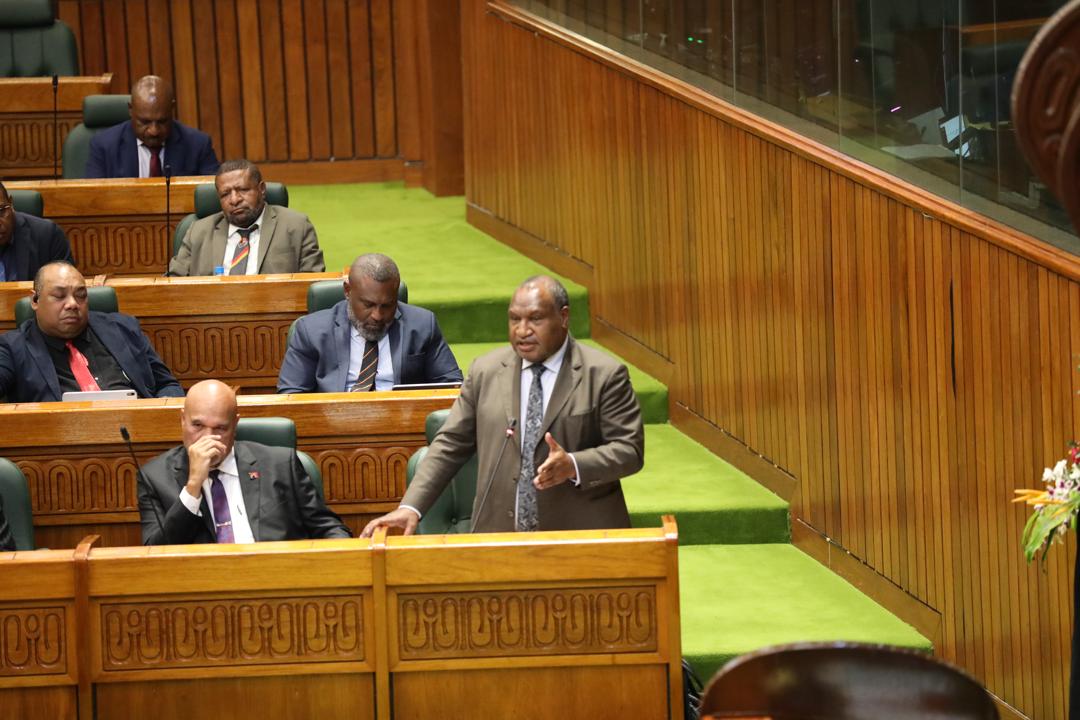

Prime Minister Hon. James Marape has welcomed the overwhelming passage of landmark Capital Markets legislation in National Parliament today, describing it as a significant Reform aimed at unlocking domestic investment, strengthening Papua New Guinea’s Financial Markets and supporting the Government’s ambition of growing the National Economy to K200 billion by 2029–2030.
The legislation, presented by Minister for International Trade and Investment Hon. Richard Maru, received strong bipartisan support from Members of Parliament on both sides of the House before being passed by 76 votes to nil, comfortably exceeding the required absolute majority of 60 votes. Speaking in support of the Bill, Prime Minister Marape said the legislation represented another important step in the Government’s continuing efforts to modernise Papua New Guinea’s Economy and create a stronger regulatory environment for investment and capital mobilisation. “This is not a mistake. This was a work in progress,” Prime Minister Marape told Parliament. “The Minister is bringing this to assist us in the construct of our economy. Since 2019, we’ve been working to grow our economy.” Mr Marape said the Government remained firmly committed to building a K200 billion Economy by the end of the decade, taking into account Papua New Guinea’s growing population and increasing demand for economic opportunities. “By 2029, if not 2030, we must have a K200 billion economy. An economy the size enough to feed a minimum 11 million people,” he said. The Prime Minister noted that Papua New Guinea’s population was growing at approximately three (3) per cent annually, making sustained economic expansion essential to improving living standards and creating opportunities for future generations. He said the proposed Reforms were particularly important as the country continued transitioning towards a larger and more diversified economy.
UNLOCKING BILLIONS IN DOMESTIC INVESTMENT CAPITAL
Prime Minister Marape highlighted the substantial Financial Resources already available within Papua New Guinea’s domestic financial institutions, including Superannuation Funds, Investment Companies and other major Institutional Investors. He pointed to the Mineral Resources Development Company (MRDC), whose total assets and business portfolio were approaching K20 billion, as an example of the significant investment capacity available domestically. He also referred to Nambawan Super and Nasfund, each with assets approaching K10 billion, demonstrating the growing strength of Papua New Guinea’s Institutional Investment Sector. “That’s domestic liquidity assets owned by three of the major Fund Managers,” Mr Marape told Parliament. He said these substantial domestic financial resources demonstrated why Papua New Guinea needed a modern Capital Markets regulatory framework capable of supporting investment opportunities and facilitating the mobilisation of capital within the country. The Prime Minister also highlighted the country’s Foreign Exchange reserves and the profitability of major financial institutions as further evidence of the increasing strength of the National Financial System. He noted that the Bank of Papua New Guinea had maintained approximately US$4 billion in Foreign Exchange reserves in recent years, while Bank South Pacific had recorded dividend payments reaching approximately K1 billion. Mr Marape also referred to the profitability of other investment funds and financial institutions as indications of the considerable Financial Resources circulating within Papua New Guinea’s economy. “So this is an indication of liquidity in the system. We want to tidy a regulator that is there,” he said.
MODERNISING FINANCIAL REGULATION TO SUPPORT ECONOMIC GROWTH
The Prime Minister said the legislation built upon earlier efforts to establish Securities Market regulation in Papua New Guinea, including Reforms initiated in the late 1990s. He noted that the country’s economy had expanded significantly since that period, requiring a more comprehensive and modern regulatory framework. “In 2019, we had an Economy that was K79 billion. Now, possibly our Economy will be K140 billion going upwards,” Mr Marape said. He explained that the proposed legislation would provide a broader framework to accommodate the changing needs of Papua New Guinea’s economy, particularly in relation to Domestic Capital Markets and investment opportunities. “We need this law to embrace domestic money markets, capital inflow, and regulate domestic money markets,” he said. The Prime Minister stressed that Papua New Guinea must not depend entirely on foreign investors to finance economic development when substantial investment resources were already available domestically. “Whilst we’re looking for investors from outside to come in, domestic investors are also around,” he said. “How to regulate so that the money market domestically is able to allow them to invest, raise capital from within, and not just dependent on foreign investments coming from outside.” Mr Marape said strengthening domestic capital markets would complement the Government’s wider economic development initiatives, including its Special Economic Zones policy and efforts to attract investment into productive sectors. A stronger Capital Markets framework would also provide opportunities for Papua New Guinean businesses to access investment financing and participate more meaningfully in National Economic Development.
BIPARTISAN SUPPORT FOR NATIONAL ECONOMIC REFORM
Prime Minister Marape commended Minister Maru for his leadership in bringing the legislation before Parliament and acknowledged the constructive contributions made by Members from both Government and Opposition. He particularly recognised the support expressed by senior Opposition Members during the Parliamentary Debate, reflecting the national importance of developing a modern financial regulatory system. The Prime Minister said the legislation was timely as Papua New Guinea continued pursuing Reforms intended to strengthen financial institutions, attract investment and support sustainable economic expansion. “This is a timely Bill, all in pursuit to have a modern Capital Market system in our country that supports our growth of economy agenda that we are working on,” Mr Marape said. He commended Minister Maru for progressing the Reform and encouraged Members of Parliament to support the legislation. The Bill subsequently received overwhelming Parliamentary endorsement, with 76 Members voting in favour and none against, surpassing the required 60-vote majority. Prime Minister Marape welcomed the outcome as an important demonstration of Parliamentary unity on legislation intended to strengthen Papua New Guinea’s economic foundations. He said the Government would continue advancing Reforms that encourage domestic investment, improve financial regulation, support private-sector growth and create opportunities for Papua New Guineans to participate in the country’s expanding economy.