



Prime Minister Hon. James Marape has welcomed growing Malaysian interest in expanding investment in Papua New Guinea’s oil palm, livestock and downstream processing sectors, describing the proposed developments as a major opportunity to create jobs, strengthen food security, increase local participation in the economy and unlock the country’s vast agricultural potential.
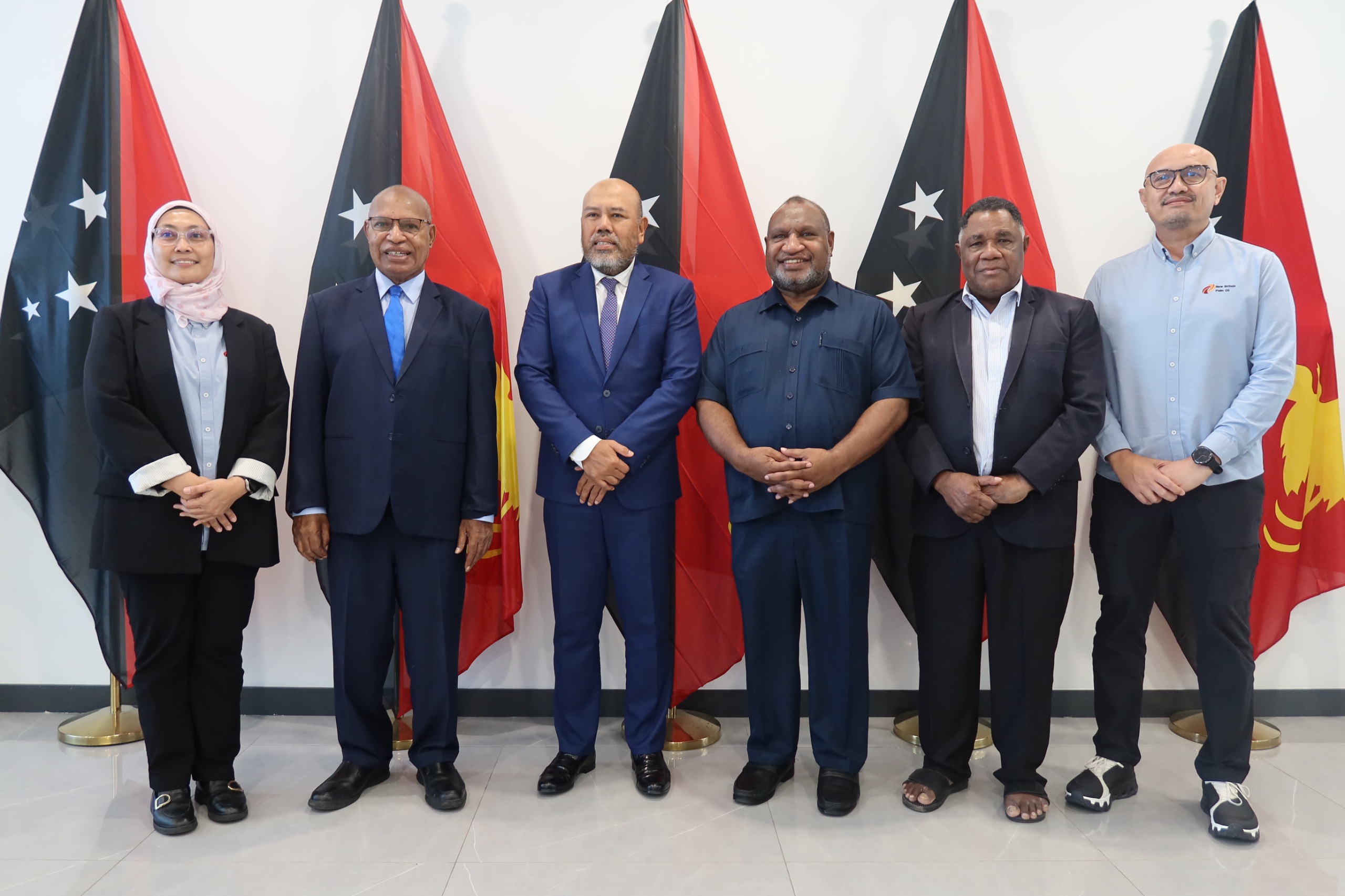
Prime Minister Marape made the remarks during a high-level meeting with Malaysian Palm Oil Board (MPOB) Chairman Datuk Mohamad Helmy Othman Basha, who also serves as Adviser to SD Guthrie, New Britain Palm Oil Chief Operating Officer Nik Maziah Nik Mustapha, and Chief Financial Officer Mohamad Mahazir Mustaffa. The meeting was also attended by Minister for International Trade and Investment Hon. Richard Maru and Minister for Oil Palm Hon. Francis Maneke.
The discussions focused on opportunities to expand oil palm and cattle production in Papua New Guinea, develop downstream processing industries, strengthen cooperation between PNG and Malaysia’s palm oil sectors, and unlock the agricultural potential of the Ramu and Sepik plains through sustainable investment.
Prime Minister Marape said Papua New Guinea remains one of the world’s last frontiers for responsible agricultural
expansion, with vast areas of underutilised land suitable for agriculture and livestock development.
“Malaysia has been one of Papua New Guinea’s most important economic partners since Independence, and we welcome investors who have demonstrated a long-term commitment to our country and our people,” Prime Minister Marape said. “We have the land, we have the people, and we have access to some of the world’s fastest-growing markets. Our task is to convert these advantages into productive economic activity that creates jobs, generates income and improves the lives of our people.”
The Prime Minister noted that New Britain Palm Oil is already one of Papua New Guinea’s largest private-sector employers, directly employing more than 22,000 Papua New Guineans while supporting thousands more through smallholder agriculture, transport, contracting and other business activities.
“This is the type of investment that creates real opportunities for our people and stimulates growth throughout the wider economy,” he said.
Prime Minister Marape also acknowledged New Britain Palm Oil’s leading role in Papua New Guinea’s palm oil industry, noting that the company remains the country’s largest palm oil producer and one of its most significant agricultural exporters.
He said the company’s operations in West New Britain, Oro, Milne Bay, New Ireland and Madang provinces have helped establish palm oil as one of Papua New Guinea’s most valuable agricultural export commodities, while vast agricultural areas such as the Ramu Plains in Madang and the Markham Valley in Morobe present significant opportunities for future expansion in agriculture and livestock production. In 2025, Papua New Guinea exported more than K3 billion worth of palm oil and palm kernel products, making the industry one of the nation’s largest non-mineral export earners and a major contributor to rural employment, foreign exchange earnings and economic growth.
“Palm oil continues to be one of Papua New Guinea’s most successful agricultural industries and one of our most important export sectors. The industry supports thousands of smallholder farmers, creates employment and generates billions of kina in export revenue for our economy,” Prime Minister Marape said.
Prime Minister Marape also acknowledged New Britain Palm Oil’s significant contribution to Papua New Guinea’s livestock industry through its operations in Ramu and West New Britain.
He noted that the company currently operates the country’s largest cattle business, with approximately 27,000 head of cattle, including around 24,000 in Ramu and a further 3,500 in West New Britain.
The Prime Minister was also informed that the company is Papua New Guinea’s largest domestic producer of fresh beef, supplying a substantial share of the national market.
“This demonstrates that agriculture is not just about oil palm. Companies such as New Britain Palm Oil are contributing to food security, livestock development and import replacement at a national level,” Prime Minister Marape said.
“As we look to expand cattle production across suitable grassland areas in the Sepik and Ramu regions, we already have successful examples of what can be achieved through long-term investment and proper management.”
Prime Minister Marape highlighted New Britain Palm Oil’s significant contribution to the national economy, noting that the company injects approximately K12 million into Papua New Guinea’s economy every fortnight through wages and salaries alone.
He said this level of direct spending demonstrates the wider value of large-scale agricultural investment beyond production and exports.
“When workers receive their pay, that money flows directly into local communities, supporting families, trade stores, transport operators, schools, churches and small businesses throughout the country,” Prime Minister Marape said.
“The impact goes far beyond the plantation itself. Every fortnight, K12 million is circulated through our economy by this company alone, creating opportunities and supporting livelihoods across Papua New Guinea.”
Prime Minister Marape also welcomed the company’s long-term investment in employee welfare, including an extensive housing replacement programme aimed at upgrading staff accommodation across its operations over the coming years.
He said agriculture remains central to his Government’s vision of achieving greater economic diversification and reducing reliance on extractive industries alone.
“The Sepik and Ramu plains represent some of the greatest agricultural opportunities in our nation,” he said. “If developed properly, we can preserve our forests, protect our waterways and at the same time create major new economic corridors that provide jobs, business opportunities and prosperity for future generations.”
Prime Minister Marape said the Sepik and Ramu plains could become one of Papua New Guinea’s most important agricultural growth corridors, supporting oil palm, livestock, food production and downstream processing industries for decades to come.
The Prime Minister said he was particularly encouraged by discussions surrounding the vast grasslands of the Sepik and Ramu regions, which offer significant opportunities for large-scale cattle development without impacting primary forests.
“We do not have to destroy our forests to grow agriculture. There are extensive grassland areas that can be converted into productive economic zones while preserving our forests and protecting our environment,” he said.
Prime Minister Marape welcomed proposals to further develop integrated agriculture projects combining oil palm, cattle and downstream processing industries.
He noted that successful agricultural models in Malaysia and Indonesia demonstrated how agriculture could support food production, manufacturing, energy security and broader economic development.
“We are not simply interested in exporting raw commodities. We want to see greater value addition, greater downstream processing and greater participation by Papua New Guineans across the entire value chain,” he said.
The Prime Minister also highlighted the enormous potential for cattle development in Papua New Guinea, noting that the country continues to import substantial quantities of beef despite possessing extensive areas suitable for livestock production. Every year Papua New Guinea spends hundreds of millions of kina importing food products that can be produced here at home,” he said. “We have an opportunity to become more self-reliant in food production while positioning ourselves to become a supplier to regional markets.”
Prime Minister Marape said the Government would continue supporting investment partnerships involving the private sector, landowners, superannuation funds and State institutions to ensure the benefits of growth are widely shared.
He welcomed ongoing discussions involving PNG’s major superannuation funds and potential public-private partnership arrangements that would allow greater Papua New Guinean participation and ownership in future agricultural developments, including proposed investments in East Sepik Province.
“We want our people to have a stake in the growth of our economy. When investments succeed, workers, landowners, smallholders, provincial governments and our citizens must all benefit,” he said.
The Prime Minister said the Government strongly supports public-private partnerships that combine international expertise, local ownership and institutional investment to accelerate national development.
Prime Minister Marape also reaffirmed the Government’s commitment to maintaining a stable and predictable investment environment supported by strong constitutional protections, an independent judiciary and the rule of law.
“Our democracy is strong. Our courts are independent. Our laws protect investors. We want investors to have confidence that Papua New Guinea is a safe and reliable place to do business,” he said.
He acknowledged concerns raised by industry representatives regarding future policy and legislative reforms affecting the oil palm sector and assured investors that consultation with industry stakeholders would continue throughout the process.
“Any law or policy we introduce must encourage investment, support smallholders, create jobs and strengthen the industry. We do not want to discourage investment. We want to create the conditions for investment to grow while ensuring our people receive fair benefits from the development of our agricultural potential,” he said.
Prime Minister Marape also pointed to the growing opportunities for downstream processing, including the production of food products, biofuels and other value-added agricultural commodities.
He noted that Malaysia and Indonesia have successfully used palm oil as part of their biofuel programmes and said Papua New Guinea should explore similar opportunities as part of its long-term energy and economic diversification strategy.
Prime Minister Marape thanked Datuk Mohamad Helmy Othman Basha and the Malaysian delegation for visiting Papua New Guinea and expressed optimism about future cooperation between PNG and Malaysia in agriculture, food , livestock development and downstream processing.
“Agriculture is the future of Papua New Guinea. If we develop our land responsibly, create opportunities for our people and partner with quality investors, we can transform rural economies, strengthen food security and build lasting prosperity for future generations,” Prime Minister Marape said.