
Prime Minister Hon. James Marape has welcomed the signing of the Project Development Agreement (PDA) for the Central Lime and Cement Project in Central Province, describing it as a major step towards strengthening Papua New Guinea’s manufacturing base, reducing import dependence, and lowering construction costs across the country.
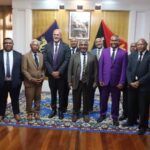
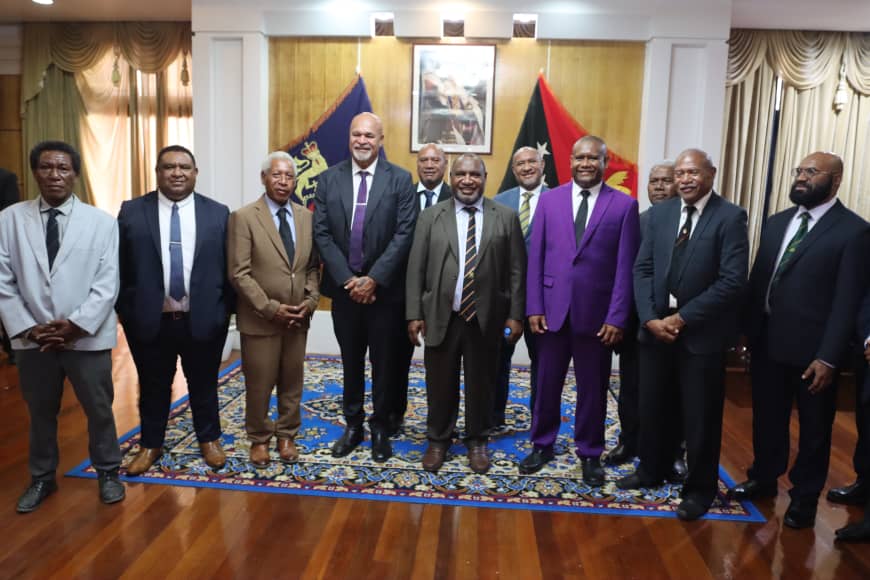
The PDA was signed this afternoon at Government House in Port Moresby, with Governor-General Sir Bob Dadae officiating at the ceremony. The agreement was signed by Mr Dairi Vele, Chairman of the State Negotiating Team (SNT), Mr Paul Mulder, Managing Director of Pacific Lime and Cement, and Mr Richard Pegum, Executive Chairman of Pacific Lime and Cement.
The agreement establishes the framework for the development of an integrated facility at Kido and Papa Rea Rea in Central Province to produce quicklime, clinker and cement for domestic and export markets.
Prime Minister Marape said the project reflected the Government’s policy of encouraging responsible investment while ensuring that landowners and local communities benefit directly.
“I want to thank the investors for showing respect to the landowners of Kido and Papa Rea Rea. That is a big tick as far as our government policy is concerned,” Prime Minister Marape said.
“We do not want to leave our landowners behind. We want to take them with us. They must have a stake in the project at all levels.”
The Prime Minister also thanked the company’s leadership for working constructively with the Government and respecting the country’s development policies.
“I want to thank the Chairman, Mr Pegum, and your entire board for your patience and for understanding how Government policy is structured in our country,” he said.
“Our intention is that landowners, the State and investors participate meaningfully in this project from beginning to end.”
Prime Minister Marape confirmed that the Government would support communities affected by the project through targeted funding. Approximately K40 million will be provided through Business Development Grants (K20 million) and Infrastructure Development Grants (K20 million) over the next two years to assist affected villages.
“These allocations ensure that communities impacted by the project can participate meaningfully in the economic opportunities created,” he said.
“We will support business development and provide infrastructure so that our people can modernise their livelihoods while maintaining their traditional identity and connection to the land.”
The Prime Minister said the project aligned strongly with the Government’s import replacement strategy, which focuses on producing and processing key materials domestically to support national development.
“Our strategy is to process our resources here in Papua New Guinea through a full value chain, meet domestic demand first, and export any surplus,” he said.
“This project will assist in reducing the cost of construction materials used in our buildings and roads across the country.”
Papua New Guinea currently imports almost all of its cement and quicklime needs.
Prime Minister Marape said developing local production would significantly strengthen the country’s economic resilience.
“This may seem like a small project, but it will have consequential positive benefits for our economy,” he said.
“The cost of construction will come down. We will see stronger, longer-lasting buildings and better roads built across our country.”
Under the agreement, 30 percent of shares in Pacific Lime and Cement will be offered to Papua New Guinean investors, including the Central Provincial Government, landowners and the National Government through a State nominee. An Initial Public Offering (IPO) is expected later this year to raise up to K1 billion to build the cement factory.
The project is also expected to create more than 2,000 jobs and support downstream industries such as brick and casting facilities.
Prime Minister Marape said the development would play an important role in supporting major infrastructure programmes such as the Connect PNG Program.
“I am looking forward to seeing the first cement produced, and I have already placed an order that I will personally buy the first bag of cement,” he said.
The Prime Minister also acknowledged the work undertaken by International Trade and Investment Minister Hon. Richard Maru, Mining Minister Hon. Solen Loifa, and government agencies in bringing the project to this stage.
“I want to thank Minister Maru and his team, as well as our State agencies and technical experts, for their diligence in ensuring that this project progresses responsibly,” he said.
Reflecting on his years in public service, Prime Minister Marape said Papua New Guinea welcomes investors who respect the country’s people, laws and environment.
“Since I first became a public officer in 2007, I have seen many investors come into our country,” he said.
“This group of investors has demonstrated that they understand the spirit of Papua New Guinea. They have shown respect for our local businesses, for the national Government, for the provinces and districts involved, and importantly for our environment.”
Prime Minister Marape reaffirmed that Papua New Guinea remains open to responsible investors committed to long-term partnerships.
“Papua New Guinea is open for business, particularly to investors who respect our people, our laws and our environment, and who are committed to working with us for shared prosperity.”