
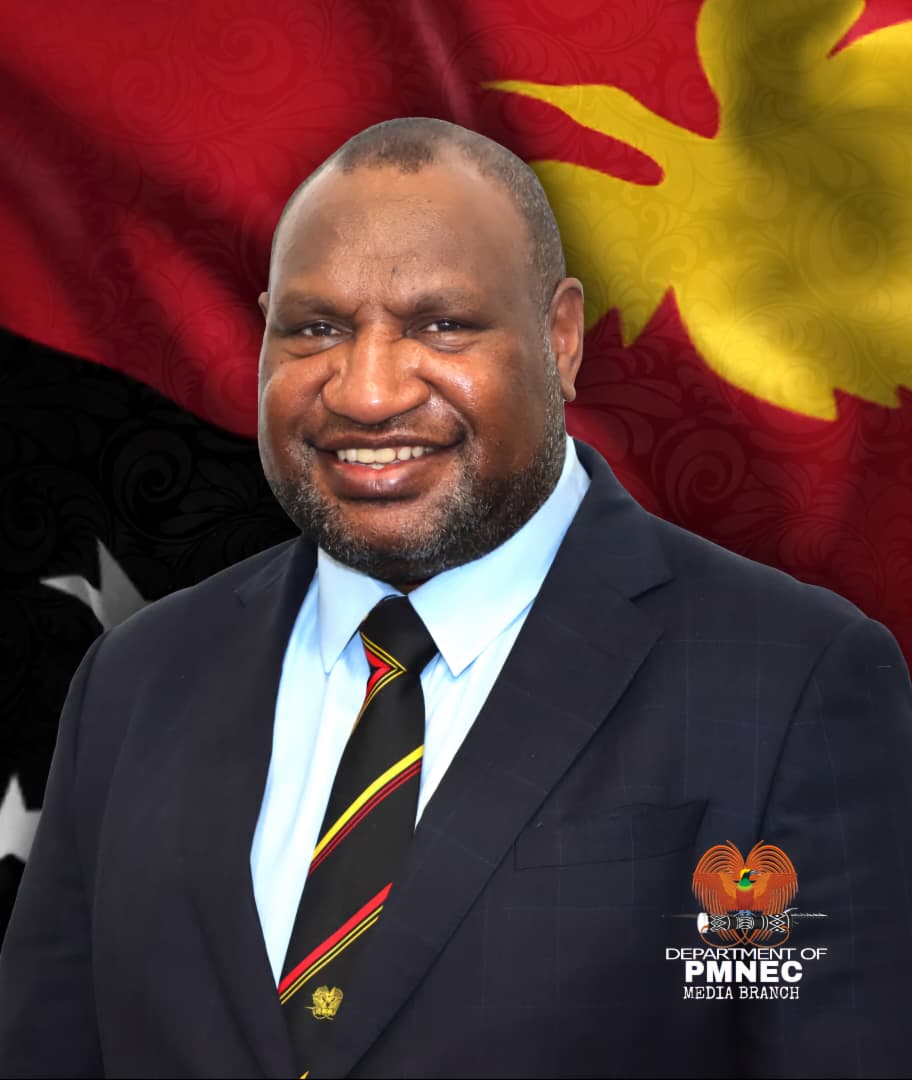

Prime Minister Hon. James Marape has underscored the Government’s long-term commitment to nationwide road connectivity under the Connect PNG programme, while outlining the financial and policy framework guiding major infrastructure contracts across the country.
Prime Minister Marape made the remarks in Parliament while responding to a series of questions from East Sepik Governor Hon. Allan Bird regarding road projects in East and West Sepik Provinces and the financing model for recently announced infrastructure contracts.
The Prime Minister began by thanking the people and leadership of East Sepik for the warm reception during his recent visit to the province, where major road projects were launched under the Connect PNG programme.
“I want to sincerely thank Governor Allan Bird and the people of East Sepik for their wonderful hospitality during our visits to Maprik and Angoram,” Prime Minister Marape said. “Maprik holds special significance for us in Pangu Pati history as the political base of the late Sir Pita Lus, one of the founding leaders who helped usher the Grand Chief Sir Michael Somare into politics in 1968. Angoram is equally significant as it is the home district of the Grand Chief Sir Michael Somare himself. It is fitting that we continue to honour these founding leaders as we build the next chapter of our nation.”
Strategic Importance of Sepik Infrastructure
Prime Minister Marape emphasised that East and West Sepik Provinces hold enormous untapped economic potential and deserve strong infrastructure investment to unlock that potential.
“When you combine East and West Sepik Provinces, their landmass exceeds 80,000 square kilometres. Together they are larger than the combined area of many Highland provinces,” he said.“These provinces possess extraordinary potential in forestry, agriculture, fisheries, tourism and cross-border trade with Indonesia. Infrastructure investment is essential to unlock that rural economic potential.”
He noted that the Sepik region also holds strategic importance for regional connectivity through the land border with Indonesia.
“Wutung is Papua New Guinea’s land bridge into Southeast Asia through Jayapura in Indonesia. The coastal highway connecting Wewak to Vanimo and onwards to Jayapura is therefore not just a provincial road — it is a strategic international economic corridor.”
Connect PNG Progress in the Sepik Region
Prime Minister Marape confirmed that major road works are already underway under the Connect PNG programme in the Sepik region, including work progressing from both the eastern and western ends of the East– West Sepik Highway.
He acknowledged that progress on certain sections has faced delays due to land issues but said those matters are now being resolved.
“There were land-related matters affecting some segments, including the Hawain Bridge area, but I understand those issues have now been attended to and works are expected to proceed,” he said. “I want to acknowledge the efforts of local leaders, including Hon. Stanley Samban, who have worked to resolve these issues so construction can continue.”
Permanent Reconstruction Instead of Temporary Maintenance
Responding to concerns raised about the Passam–Maprik road section, Prime Minister Marape explained that the Government opted for permanent reconstruction rather than temporary maintenance.
He said the Government respects the support of development partners such as Australia, but believes some key roads require full restoration to support long-term economic development.
“In some cases, maintenance or gravel rehabilitation may keep a road passable temporarily, but we want permanent restoration for major economic corridors,” he said. “If we spend tens of millions of kina on temporary maintenance that washes away after a few rainy seasons, it does not give lasting value to our people. For critical economic roads such as Passam to Maprik — which serves cocoa, vanilla and local produce markets — we want a permanent sealed road solution rather than short-term fixes.”
Long-Term Vision of Connect PNG
Prime Minister Marape reiterated that Connect PNG is a 20-year national infrastructure programme designed to permanently connect communities across the country.
“Connect PNG is not a short-term political project. It is a 20-year national vision,” he said. “Even if my government is not in office in future years, I urge all future governments never to abandon road connectivity for our people.”
He noted that economists consistently highlight the economic multiplier effect of road investment. “Economic analysis shows that every one kina invested in road construction returns up to four kina to the national economy through increased production, market access and economic activity.”
Financing Model for Infrastructure Projects
Prime Minister Marape also addressed questions regarding the financing model for recently announced road contracts, some of which use a design–finance–build structure. Under this model, contractors are responsible for designing the road to national standards, financing construction and building the infrastructure, with the State repaying the cost over several years.
Prime Minister Marape said the model operates within the legal framework established under the Connect PNG Act. “The Connect PNG Act sets aside 5.6 per cent of every national budget specifically for road infrastructure,” he explained.
“This guaranteed allocation allows the Government to forward-contract road projects within a 20-year programme framework.”
He emphasised that these contracts are structured within the Act and do not automatically increase the State’s formal debt profile.
“Technically some may describe them as future obligations, but legally they operate within the Connect PNG framework which quarantines funding for road construction. As the national budget grows — from around K14 billion in 2018 to over K30 billion today — the 5.6 per cent allocation increases accordingly, enabling us to sustain these contracts over time.”
Stage One and Stage Two Expansion
Prime Minister Marape confirmed that the Government is approaching the upper limits of Connect PNG Stage One, which is valued at approximately K7–8 billion.
However, planning for Stage Two is already underway.
“We are now looking at transitioning into Stage Two while completing key missing links in Stage One,” he said. These include strategic economic corridors such as:
• Karamui–Bundi–Madang Road
• Additional New Britain Highway sections
• Oro Province linkages
• Further connections in Manus and other regions.
“These roads are what I call the economic arteries of our country,” he said. “They connect areas of forestry, cocoa, coffee, oil palm and other agricultural production to markets.”
Roads Driving Economic Growth
Prime Minister Marape said the broader goal of the programme is to stimulate economic activity across rural Papua New Guinea.
“When roads open, markets open,” he said.
He cited the example of the Kikori–Erave road where communities have already begun transporting seafood, sago and other produce to highland markets.
“I recently spoke to a woman councillor in Kikori who told me that after the road opened, she now earns between K16,000 and K20,000 from trips selling seafood and produce to Highland markets. This is the transformation we want — where infrastructure allows ordinary Papua New Guineans to participate in the economy.”
National Development Vision
Prime Minister Marape concluded by stressing that the Connect PNG programme is a national development strategy that must continue regardless of political changes.
“This is not about politics or one government. This is about building a connected nation,” he said. “Our goal is simple
— to connect every province, every district and every economic region so that Papua New Guinea’s farmers, fishermen, entrepreneurs and communities can fully participate in our national economy. Into our nation’s 50th year and beyond, connectivity will be the foundation for inclusive economic growth across Papua New Guinea.”