
Prime Minister Hon. James Marape has commended the International Monetary Fund (IMF), the World Bank Group and the World Trade Organisation (WTO) for their continued partnership and support as Papua New Guinea progresses steadily towards fiscal stability, a balanced national budget and a long-term debt-reduction path.
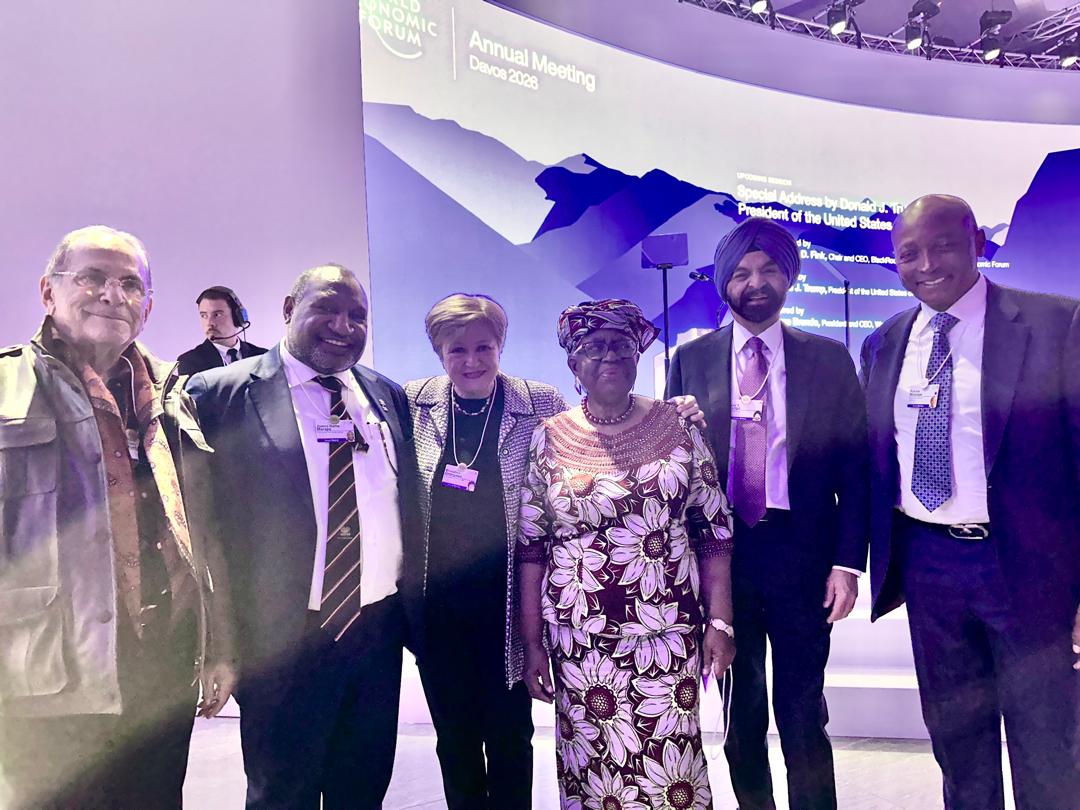
The Prime Minister made the remarks following high-level meetings with IMF Managing Director Ms Kristalina Georgieva, World Bank Group President Mr Ajay Banga, and WTO Director-General Dr Ngozi Okonjo-Iweala on the margins of the World Economic Forum Annual Meeting in Davos.
Prime Minister Marape said the consistent engagement of the IMF and World Bank — particularly through policy advice, technical support and access to concessional financing — had been critical in helping Papua New Guinea rebuild its economy following the severe global shock caused by COVID-19.
“I expressed my sincere appreciation to both the IMF and the World Bank for their strong and consistent presence in Papua New Guinea,” Prime Minister Marape said.
“Their assistance has enabled us to stabilise our economy, access affordable concession lending, and place the country firmly back onto a credible fiscal consolidation path.”
The Prime Minister said Papua New Guinea recorded a budget deficit of 8.9 per cent of GDP during the COVID-19 period, reflecting the unprecedented global crisis experienced by economies worldwide.
“Over the past five years, my government has deliberately pursued fiscal consolidation,” he said.
“We have reduced the deficit every year — from 8.9 per cent after COVID-19 to 1.1 per cent in 2026, which is among the lowest deficit levels recorded in recent decades.”
Prime Minister Marape told the IMF and World Bank leadership that Papua New Guinea is now positioned to deliver a balanced national budget in 2027, which would be the country’s first balanced budget since the late 2000s.
“I gave them my fullest assurance that next year we will return to a balanced budget,” he said.
“From 2027 onwards, there will be no new borrowing for budget financing, and the Government will move onto an aggressive debt-repayment path.”
He said the Government’s objective is to reduce the debt-to-GDP ratio to below 30 per cent by 2030, in line with Papua New Guinea’s 13-Year Medium-Term Fiscal and Debt Strategy.
According to Prime Minister Marape, both the IMF and World Bank commended the Government’s strict adherence to its own fiscal framework and the discipline demonstrated over the past five years.
“The IMF Managing Director acknowledged that Papua New Guinea’s fiscal consolidation has been exceptionally strong by global standards,” he said.
“She noted that Papua New Guinea may be among the top ten countries globally that have reduced budget deficits most aggressively, moving back towards a balanced budget within a five-year period.”
Ms Georgieva cautioned, however, that the global economy remains fragile and volatile due to geopolitical tensions, climate-related events and external shocks beyond the control of individual nations.
“She advised that while external events — such as conflicts or climate change — cannot be controlled, what countries can control is productivity and economic diversification,” Prime Minister Marape said.
“She strongly encouraged Papua New Guinea to broaden its economic base beyond mining and petroleum.”
The IMF Managing Director welcomed the Government’s renewed focus on agriculture, manufacturing and downstream processing, noting that increased domestic production would strengthen resilience and long- term growth.
“As productivity rises, countries are better positioned to trade with the world and withstand global shocks,” the Prime Minister said.
Prime Minister Marape also met with WTO Director-General Dr Ngozi Okonjo-Iweala, who expressed strong interest in visiting Papua New Guinea in the near future.
“She highlighted that although the global trading environment appears disrupted, approximately 75 per cent of global trade continues to operate within the WTO framework,” he said.
“She encouraged Papua New Guinea to maintain stable trade relationships, expand production, identify suitable export markets and continue engaging confidently within the multilateral trading system.”
The Prime Minister further revealed that World Bank Group President Mr Ajay Banga has also indicated his intention to visit Papua New Guinea, reflecting growing international confidence in the country’s reform agenda.
Prime Minister Marape said the discussions in Davos reaffirmed that Papua New Guinea’s economic direction is gaining international recognition.
“Our message is clear — discipline, stability and long-term planning,” he said.
“We are reducing deficits, restoring balance to our national budget, strengthening domestic production, diversifying our economy and positioning Papua New Guinea for sustainable growth as we enter our next 50 years as a nation.”