




Prime Minister Hon. James Marape has reaffirmed his government’s unwavering commitment to agriculture as the central pillar of Papua New Guinea’s economic transformation, declaring that the sector holds the key to creating one million sustainable family-based livelihoods across the country.
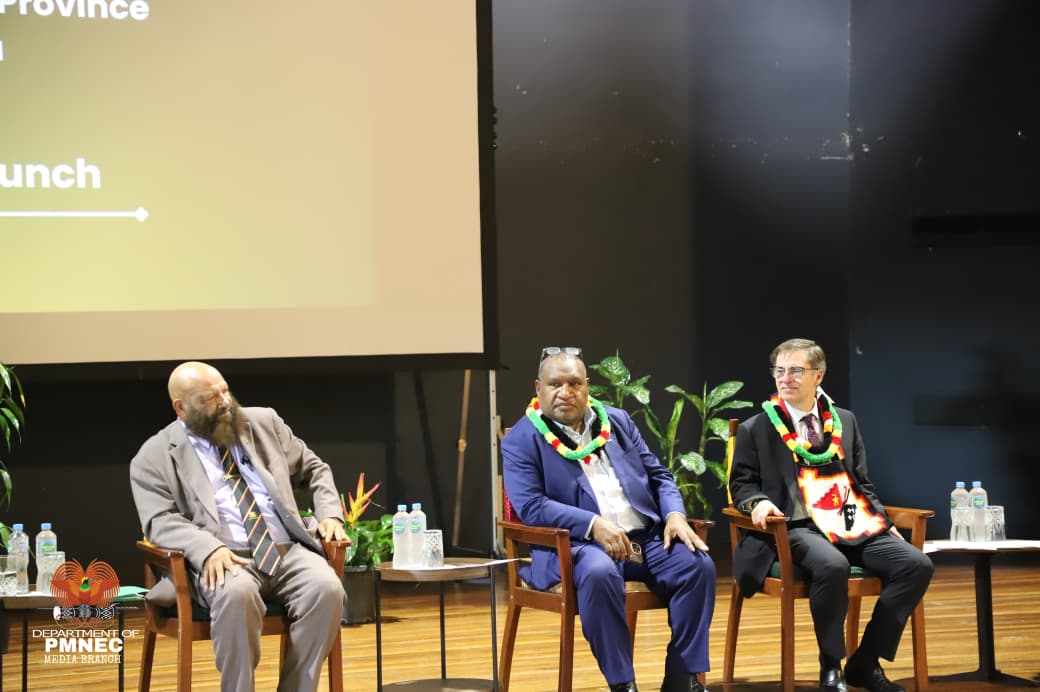
At the launch of the AgriConnect programme in Goroka, Prime Minister Marape welcomed a US$250 million partnership programme supported by the World Bank, Asian Infrastructure Investment Bank, International Fund for Agriculture Development (IFAD), International Finance Corporation (IFC) and other like-minded partners, describing it as a strategic intervention designed to link farmers, entrepreneurs and agribusinesses across Papua New Guinea in a coordinated and structured manner.AgriConnect supports the National Agriculture Sector Plan 2024-2033. Prime Minister Marape was joined by World Bank Vice-President, East Asia and Pacific, Carlos Felipe Jaramillo, and IFC Vice-President, Asia and Pacific, Sarvesh Suri
He said agriculture remains PNG’s greatest untapped opportunity for broad-based job creation and long-term economic security.
The Prime Minister acknowledged the leadership of Minister for Agriculture Hon. John Boito and sector ministers responsible for coffee, oil palm and livestock, noting that the deliberate creation of four standalone agricultural ministries in 2022 was aimed at restoring focus, accountability and performance in a sector that supports the majority of Papua New Guineans.
“Agriculture has remained our number one focus. We deliberately restructured the sector because we need results. This is where our greatest strength lies,” Prime Minister Marape said.
Strategic Partnerships
Prime Minister Marape expressed sincere appreciation to the World Bank, Asian Infrastructure Investment Bank, IFAD and IFC for their support.
“This partnership programme is about ensuring that our intentions in agriculture are properly aligned, coordinated and delivered in a structured way. It will connect our farmers, our entrepreneurs and our agribusiness community across the country.”
He said his government had made it clear to development partners several years ago that agriculture would remain a central national priority.
“A few years ago, I made it clear that our focus is in this space — empowering our farmers, strengthening agribusiness, and building sustainable economic growth from the ground up,” he said.
He conveyed appreciation to World Bank Group President Ajay Banga for approving the facility.
“Please convey my thanks to President Ajay Banga and to all of you for approving this important facility. We sincerely appreciate your support and confidence in Papua New Guinea.
“Now we must get to work.”
Prime Minister Marape called on all provincial governments to demonstrate strong ownership of the programme.
“Your people are in your provinces. Let us work together and demonstrate true partnership in action,” he said. Launching the initiative in Eastern Highlands Province, the Prime Minister announced that the province would serve as the focal point of the programme’s rollout.
“Since we are launching this initiative here in Eastern Highlands Province, we will ensure that this province becomes the capital of this programme.”
Agriculture Versus Extractive Growth
Prime Minister Mar ape drew a clear distinction between extractive industries and agriculture, emphasising that while new mining and petroleum projects will increase GDP, they will not create the scale of employment needed for PNG’s growing population.
He noted that more than 100,000 young Papua New Guineans enter the job market each year, and even multiple new resource projects would not absorb this number.
“We cannot rely solely on mining and oil and gas for mass employment. Agriculture is where we can create economic activity for families across the country,” he said.
Customary Land Reform to Unlock Growth
The Prime Minister announced that Government is progressing policy reforms to properly recognise and register customary land ownership in a manner that enables families to access long-term agricultural financing.
Under the proposed approach, families will be able to utilise their land through structured long-term arrangements, including 49-year development leases supported by institutions such as the National Development Bank.
Massive Regional Market Opportunity
Prime Minister Marape highlighted strong international demand for PNG agricultural produce, noting that Asian markets alone provide access to more than four billion consumers.
“The market is there. The opportunity is there. The question is whether we are ready to produce at scale,” he said.
One Million Families, K10 Billion Annual Injection
Using current commodity examples, Prime Minister Marape illustrated how families can generate meaningful annual income through modest production levels of coffee, cocoa, copra and fresh produce .
He emphasised that if one million families each earn a minimum of K10,000 annually from agricultural activity, this alone would inject at least K10 billion into the national economy every year .
“If one million families earn K10,000 a year, that is K10 billion added into the economy annually. The earning power is already there,” he said .