




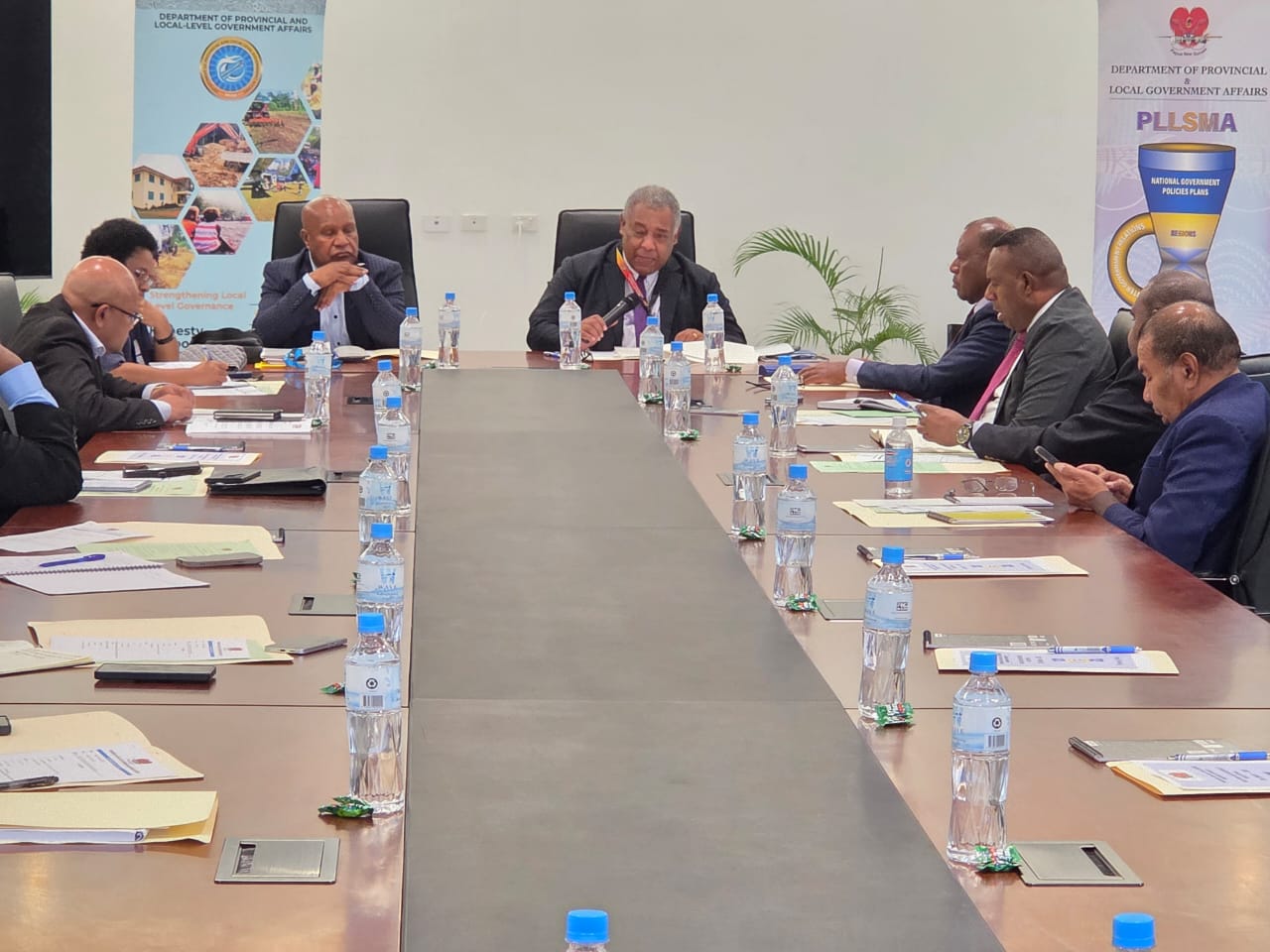

Chief Secretary to Government, Ivan Pomaleu, OBE, has addressed members of the Provincial and Local Level Services Monitoring Authority (PLLSMA) at the first meeting for 2026, setting out urgent reforms to drive accountability, improve service delivery and align sub-national systems with the Government’s Reset@50, 20 Year Road Map and Vision 2050.
Mr Pomaleu thanked DPLGA Secretary Philip Leo and PLLSMA members for their attendance and emphasized that the Prime Minister has directed a renewed focus on lifting public sector performance — “there is no time to waste.”
He highlighted that the Government expects a clear shift away from business as usual towards outcomes-driven delivery.
“The National Monitoring & Coordination Authority (NMCA) and the Reset 50 Road Map are central to that shift,” he said.
Mr Pomaleu reiterated that he is there to steer these two important agendas. He said the Government has required them to reset, re-calibrate and refocus their practices, and demand transformational leadership at every level.
1. Role of the NMCA: Cabinet-approved, the NMCA will provide strategic oversight and whole-of- government coordination. It will drive discipline, transparency and results-based systems to correct delays, fragmented coordination and inconsistent policy-driven budgeting. The NMCA is a steering and monitoring mechanism — not an implementer.
2. Modernized monitoring: NMCA will adopt real-time monitoring, digital dashboards, GIS mapping and AI-enabled audits to follow money trails and independently report progress to the Chief Secretary’s office. Inclusion of provinces and districts in results tracking is a priority.
3. PLLSMA realignment: An urgent review and realignment of PLLSMA functions to ensure coherence with NMCA. He urged Secretary DPLGA and the PLLSMA mechanism to become more responsive, results-focused and accountable to the sub-national sector.
Chief Secretary Pomaleu outlined two immediate priorities for the next three to six months:
1) Functional Assignment Determination (FAD) — Clear definition of functions and responsibilities across national, provincial, district and LLG levels to enable evidence-based, policy-driven budgeting and real-time performance tracking.
2) National Policy on Decentralization — A completed and finalized policy (to be completed before March 2026) to provide a clear framework for autonomy proposals, power-sharing arrangements and decentralization reforms, including consideration of options such as a quasi-federal model and bicameral legislature as outlined under Reset 50.
– Public finance and outcome-based budgeting: The need to move from traditional program-based budgeting to outcome-based budgeting. NMCA will monitor performance of the national budget and national transfers (including PIPs and SIPs) to ensure funds achieve measurable impact. DIRD and NEFC were commended for recent work addressing intergovernmental financing issues.
– Review of the Centre: A comprehensive “Review of the Centre” will redefine central coordination roles of CACC agencies to ensure the engine room of government is fit for purpose. The NMCA’s effectiveness depends on a well-ordered central coordination system.
He urged all heads of departments, CACC agencies and PLLSMA members to embrace decisive, transformational change — to re-strategize priorities, break down silos and strengthen collaboration across sectors.
“As Albert Einstein warned, it is insanity to do the same thing over and over while expecting different results. We must embrace drastic, uncompromising change to reposition, refocus and reset our course for better results,” the Chief Secretary said.
Mr. Pomaleu reaffirmed that NMCA will be the delivery mechanism for the Reset 50 reforms and reiterated the Government’s expectation for timely, accurate and evidence-based provincial reporting under Section 119.
He closed with a call for collective leadership to deliver improved services and outcomes for all Papua New Guineans.