
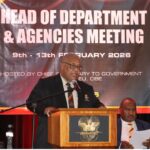
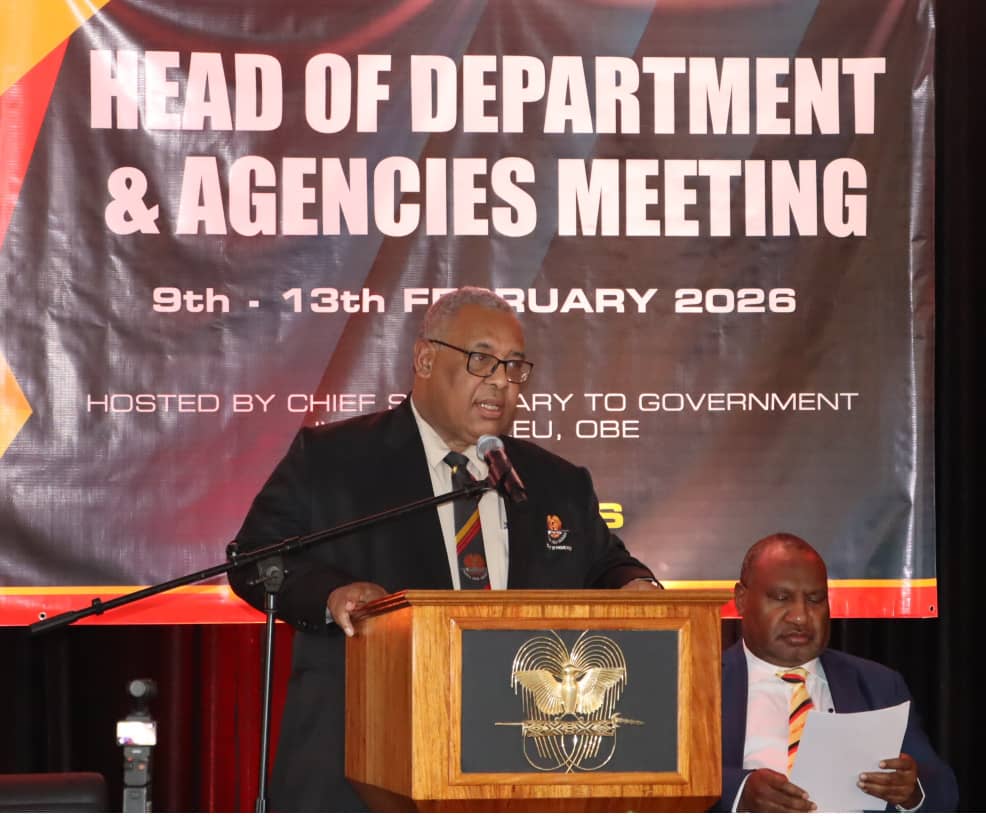

Chief Secretary to Government Ivan Pomaleu, OBE has told Heads of Departments and Government Agencies to work in collaboration and achieve National Development Goals and Priorities of the National Government.
The Chief Secretary made this statement following a recent five-day Heads of Department and Agencies Meeting involving 77 Government Departments and Agencies in Port Moresby.
The Theme of the gathering was to shift focus from “systems building to results delivery,” which underpins measurable outcomes and cross-agency collaboration to achieve National Development Goals and Agenda.
It aims to review the Performance, Priorities for 2026, Opportunities, and Challenges faced by various agencies since 2019, encouraging a unified approach.
Upon delivering his closing remarks, Mr. Pomaleu outlined National Development Targets (MTDP4) with the Government’s core objectives to grow the economy by K200 billion in the next decade.
Mr. Pomaleu reaffirmed the National Government plans to create 1 million jobs to elevate the Human Development Index (HDI) from 0.57 to 0.75% by 2045, which requires an annual improvement of at least 0.1% which he had emphasized that every policy and project must center on lifting the HDI.
Upon discussing the economic Reality and Areas of Focus in relation to the Current Economic Landscape, he said according to the Central Bank’s update it revealed 3-4% growth, with 4.7% inflation, a 6% depreciation of the currency, and a concern that resource sector income is not adequately flowing into the domestic economy. This indicates a reliance on commodity-driven growth without sufficient job creation or local income circulation.
Therefore, Mr. Pomaleu highlighted that essential Pillars for Growth must be focused on agriculture, tourism, import replacement, and mandatory public sector reforms to ensure growth impacts people’s lives.
Further, he said that there are specific Initiatives and Sector Potential Land Partnership Initiative which encouraged structured partnerships between customary landowners and developers, particularly in agriculture, to free up land for food and cash crop production without significant direct government funding. This is expected to create jobs, increase production, and boost rural incomes.
The Chief Secretary said there must be Cross-Agency Collaboration in relation to Roads & Services which he has called for integrated planning between Departments like Works and Lands to ensure that new road infrastructure also facilitates land availability for government services along corridors, bringing essential services to previously isolated communities.
Mr. Pomaleu stressed that there must be Procurement Reforms deemed central for faster service delivery, better value for money, and reducing corruption perceptions and reforms aim to streamline processes, improve contract administration, and ensure public funds translate into tangible services.
He emphasized that PNG has a Tourism Potential which the sector currently supports 40,000-45,000 jobs. A target of 650,000 visitor arrivals by 2027 could generate K1 billion annually and create over 200,000 jobs.
However, the Chief Secretary also highlighted some pertinent issues to address which include high airfares, limited seat capacity, and persistent safety/security concerns through aggressive inter-agency collaboration, drawing lessons from successful Pacific nations like Fiji.
Mr. Pomaleu mentioned that some Cross-Cutting Issues and Priorities for this meeting revealed systemic issues which have to be addressed forthwith:
• Chronic Underfunding: Inadequate and delayed budget releases.
• Staffing Challenges: Shortages and retention issues across agencies.
• Digital Transformation: Slow progress and lack of affordable internet access.
• Governance Gaps: Issues in compliance and accountability.
He said this is due to Weak Coordination and Poor Collaboration between National, Provincial, and District Levels and Provincial Reform Bottleneck, which the 1995 provincial reform was identified as a significant impediment.
As such, the Chief Secretary has proposed some priority areas to work on for the whole-of-Government system which include:
• Strengthening institutional and technical capacity.
• Improving public financial management and discipline.
• Enhancing service delivery, especially in provinces.
• Investing in ICT systems and case management platforms.
• Accelerating key legislative reforms.
Meanwhile, Mr. Pomaleu has called for immediate actions and future plans for Departmental Realignments which involves Internal regrouping into clusters to handle policy matters, NEC submissions, and performance reports, institutionalizing coordination and accountability.
He pointed out that Key Reforms Initiated on Public finance management, public sector, and State- Owned Enterprise (SOE) sector reforms are underway, alongside strengthening the Chief Secretary’s coordinating authority to address systemic issues.
In addition, he mentioned that for the Teaching Services Commission full implementation of NEC Decision No:63/2015 regarding the Teaching Services Commission is proposed.
The Chief Secretary has reiterated that the Reset Delivery Unit will be a dedicated unit which will coordinate all reforms, with a consultative meeting commencing on February 17th 2026.
Mr. Pomaleu stressed that for Data Capture purposes all Agencies are requested to link their ICT teams to a central data dump to capture raw data for informed decision-making.
“For Performance Review the NMCA will review all presentations, conduct a reality check, and provide feedback, he said.
Also, the Chief Secretary said Regular Review Meetings are planned to become regular events, with the next one anticipated in July or August expecting more refined reports with clear links to strategic priorities (SPAs) outputs and outcomes.
The Chief Secretary concluded by thanking all Agency Heads and Officers for their contributions, noting that the collective effort enables the Government to compile a comprehensive report before March 31st 2026.