
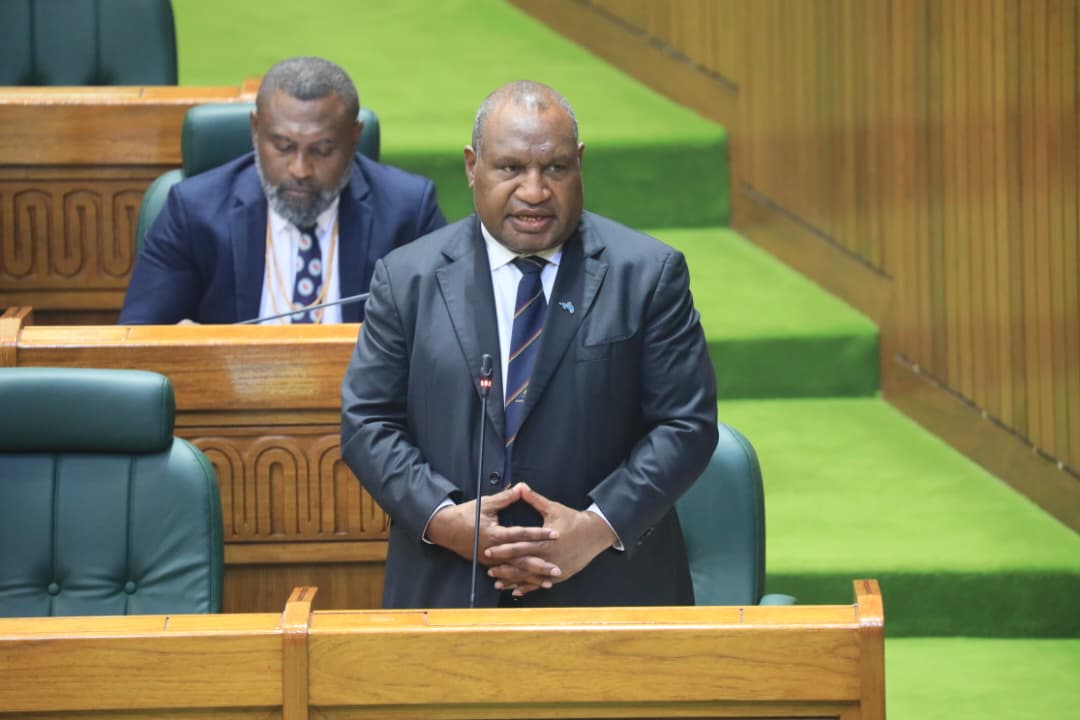

Prime Minister Hon. James Marape has called on Members of the National Parliament to approach the historic Debate on the Bougainville Referendum with wisdom, respect, unity and a shared commitment to finding a peaceful and mutually acceptable outcome for Bougainville and Papua New Guinea.
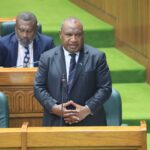
Speaking in Parliament today, Prime Minister Marape described the occasion as a defining moment in the nation’s history, requiring careful consideration of Bougainville’s aspirations for Political Independence alongside the constitutional responsibility to safeguard Papua New Guinea’s sovereignty and national unity. “We have no choice but to deal with this issue,” Prime Minister Marape told Parliament, acknowledging the overwhelming 97.7 per cent vote for Independence recorded during the 2019 Bougainville Referendum. The Prime Minister expressed appreciation to the people and leadership of Bougainville for their patience, understanding and commitment to the Peace process, particularly following the devastating Bougainville Crisis, which claimed thousands of lives and left lasting scars on communities. “I want to firstly register my word of appreciation to our brothers and sisters in Bougainville for their patience, their tolerance and their understanding,” he said.
Prime Minister Marape reflected on the historical circumstances surrounding the Bougainville conflict, which began in the late 1980s, and the subsequent Peace process that culminated in the signing of the Bougainville Peace Agreement in 2001. The Agreement established the foundations for Autonomy, Weapons Disposal and a Referendum on Bougainville’s future political status. The Referendum, conducted from November 23 to December 7, 2019, resulted in approximately 97.7 per cent of Voters choosing Independence over Greater Autonomy. Prime Minister Marape said the Referendum outcome represented an unmistakable expression of the wishes of the Bougainville people, which must be treated with seriousness and respect through the Constitutional process. However, he emphasised that the Referendum was non-binding, with the Constitution providing for Post-Referendum Consultations between the National Government and Autonomous Bougainville Government before the matter is considered by the National Parliament. He highlighted Section 342 of the Constitution as an important mechanism allowing both Governments to continue Consultations towards an agreed outcome. “Section 342, Subsection 1, is a timeless bridge between the past and the future,” he said.
The Prime Minister acknowledged the contributions of successive National and Bougainville Leaders towards maintaining Peace and advancing the Political Process, including former Prime Minister Late Sir Mekere Morauta, former Bougainville President Dr John Momis and current President Ishmael Toroama. He also reflected on significant Consultations held in Kokopo, Wabag and other locations, which helped strengthen dialogue, mutual understanding and cooperation between both Governments. Prime Minister Marape said his responsibility as Head of Government extended beyond addressing Bougainville’s aspirations to ensuring that the Constitutional integrity and sovereignty of Papua New Guinea remained protected for future generations. “My challenge as Papua New Guinea Prime Minister is to hold this diverse nation’s sovereignty together,” he said. He cautioned that Parliament must carefully consider the broader national implications of its decision, particularly in a country characterised by extraordinary cultural, linguistic and geographical diversity. “This diversity makes us blend into a symphony of one nation, one people,” he said.
On the Parliamentary process going forward, Prime Minister Marape clarified that every Member of Parliament would be given the opportunity to speak on the matter, representing the views and interests of their respective people and electorates. He said Parliamentary statements and deliberations would continue on Thursday and Friday this week, before Parliament takes up the matter again in November, when a Vote would subsequently be conducted. The Prime Minister further clarified that the outcome of the Parliamentary Vote would then be formally transmitted to the Bougainville House of Representatives as part of the continuing Political and Constitutional process. He emphasised that this approach would allow adequate time for Elected Representatives to carefully consider the historical, constitutional and national implications of the Bougainville question. “Each of us must speak for Bougainville and for country. And we must find a win-win solution,” Prime Minister Marape said. He stressed that the Government remained committed to Peaceful Dialogue and the Constitutional Process, rather than allowing historical grievances or political differences to undermine the Peace achieved over many years.
The Prime Minister informed Parliament that he would reserve his concluding contribution until Members had been given sufficient opportunity to express their views. He emphasised that the matter must not be rushed, given its profound implications for Bougainville, Papua New Guinea and future generations. “As we work through this, let’s ponder on some of this discussion and let’s find something that doesn’t hurt Bougainville’s aspiration for self- determination, but at the same time assists me and future Prime Ministers the ability to hold this diversity called Papua New Guinea together,” he said. Prime Minister Marape concluded by calling for continued patience, understanding and prayer as Parliament undertakes one of the most consequential Constitutional and Political deliberations since Papua New Guinea attained Independence in 1975. “May God bless Bougainville. May God bless Papua New Guinea as we work our way through this important issue.”