

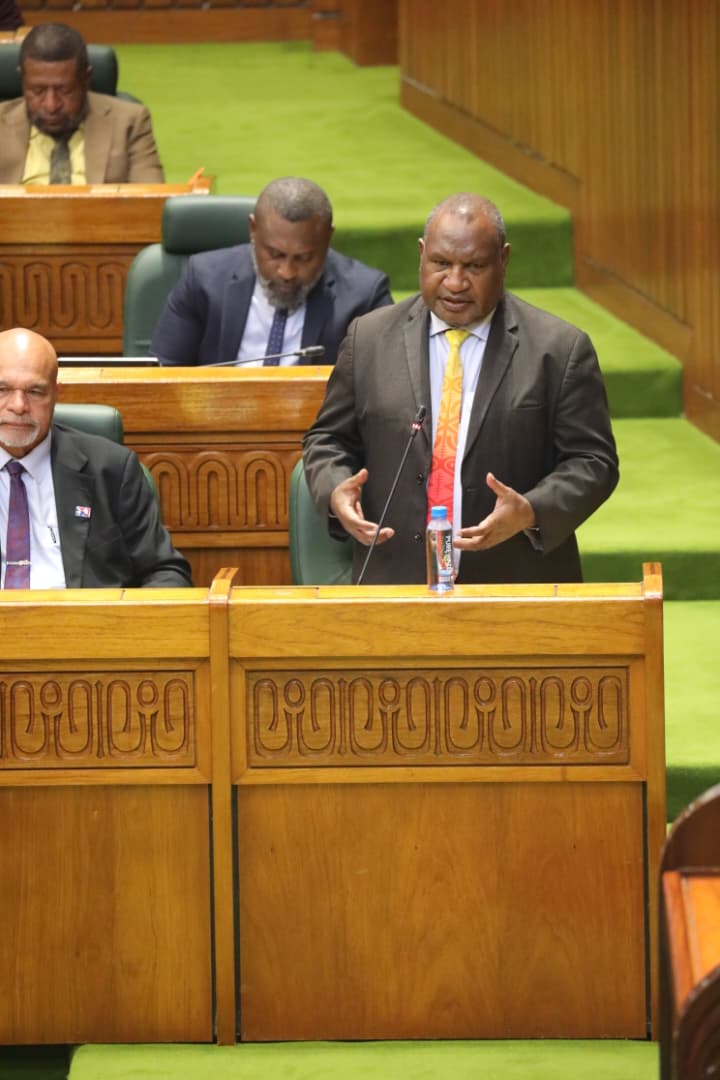

Prime Minister Hon. James Marape has assured Parliament that the Government will review the recently amended Infrastructure Tax Credit Scheme (ITCS) to address concerns over bureaucratic delays, provincial representation and the timely delivery of development projects in resource-producing areas.
Prime Minister Marape gave the assurance in Parliament today while responding to questions without notice from Deputy Opposition Leader and Hiri-Koiari MP Hon. Keith Iduhu, who raised concerns about amendments to the Income Tax Act and the establishment of a new Infrastructure Tax Credit Development Board.
Mr Iduhu questioned whether the new arrangements would centralise decision-making in Waigani, delay infrastructure projects and undermine agreements between resource developers, landowners and host communities.
Prime Minister Marape explained that the amendments were introduced to strengthen revenue management, improve accountability and ensure tax credit-funded infrastructure was coordinated with national development priorities.
“The intention of Government is not to frustrate development in project areas, but to ensure that tax credits, which represent national revenue forgone, are properly managed and fairly distributed,” Prime Minister Marape said.
“These are not simply company projects. They are infrastructure projects funded through government revenue that would otherwise be collected as tax.
“We must ensure that these resources are properly accounted for, that existing project agreements are respected, and that development benefits reach all parts of our country.”
Prime Minister Marape said the Government had increased the infrastructure tax credit threshold from the previous 0.75 per cent to 3 per cent, providing greater opportunities for infrastructure development.
He explained that the revised allocation framework provides:
• 1.5 per cent for infrastructure development in resource project areas;
• 1 per cent for infrastructure projects in other parts of Papua New Guinea; and
• 0.5 per cent specifically for infrastructure development in Bougainville.
“This means project area provinces are not missing out. In fact, they now have a dedicated allocation of 1.5 per cent, compared with the previous arrangement of 0.75 per cent, where projects competed more broadly for funding,” he said.
Prime Minister Marape said the new arrangements would allow Treasury to maintain a comprehensive record of tax credit-funded projects and ensure that national budget allocations were directed towards communities and provinces not benefiting from major resource developments.
He acknowledged concerns raised by Mr Iduhu and Hela Governor Hon. Philip Undialu regarding excessive bureaucracy and possible delays to projects.
“I appreciate the concerns raised by the Deputy Opposition Leader. If there are teething issues with the legislation, the board’s operations or representation, we will certainly look into them,” Prime Minister Marape said.
“This is not a holy commandment. The legislation can be amended and the arrangements can be improved to ensure that we do not undermine the original intention of the tax credit scheme.
“We want the system to work easier, quicker and better, while honouring our obligations and delivering development to our people.”
Prime Minister Marape said his department would work with Treasury to examine the concerns, with Cabinet to consider any necessary improvements.
He indicated that corrective measures could be brought before Parliament during the forthcoming November–December budget sitting.
“I give my fullest assurance that we will review these matters. Where changes are necessary, we will make them,” he said.
“Our objective is to protect government revenue, honour project agreements, support resource-producing communities and ensure infrastructure development is fairly spread across Papua New Guinea.”
Prime Minister Marape reaffirmed that the Government remained committed to using the Infrastructure Tax Credit Scheme to deliver roads, bridges, schools, health facilities and other essential infrastructure while maintaining transparency, accountability and fiscal discipline.