






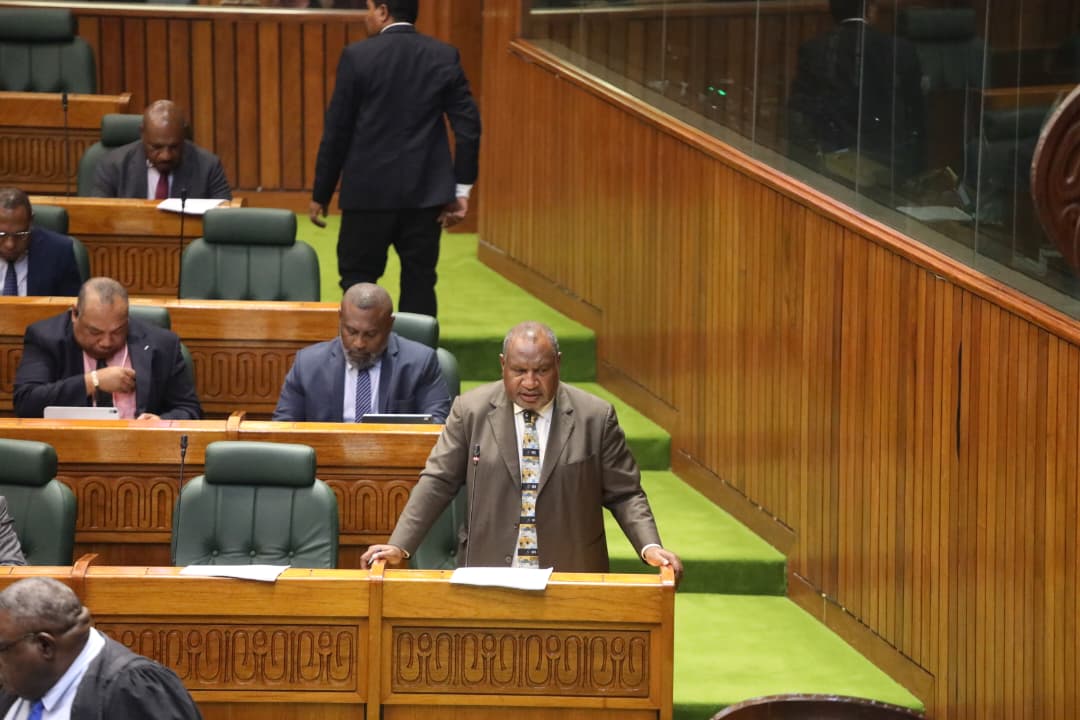

Prime Minister Hon. James Marape has welcomed Parliament’s passage of the Prime Minister (Amendment) Bill 2026, aimed at strengthening whole-of-government coordination, improving Cabinet decision-making processes and recognising the growing importance of information and communications technology in Papua New Guinea’s development.
The amendment to Section 24 of the Prime Minister Act 2002 provides for the inclusion of the Secretary to the National Executive Council (NEC) in the Central Agencies Coordinating Committee (CACC), strengthening coordination between Cabinet and the central agencies responsible for implementing government policies and decisions.
The reforms also provide for the inclusion of the Department of Information and Communications Technology (DICT) in the CACC, recognising ICT as a major driver of the present and future economy.
Introducing the Bill in Parliament today, Prime Minister Marape described the amendment as a simple but important reform aimed at improving the machinery of government and ensuring greater coordination across government departments and agencies.
“This is a simple amendment to the Prime Minister Act. This amendment pertains to Section 24 of the principal Act,” Prime Minister Marape told Parliament.
“It brings the Secretary for NEC into the Central Agencies Coordinating Committee. It empowers the Secretary to assist the Prime Minister and NEC in making sure NEC carries out its duties at the central agency level.”
Prime Minister Marape said the NEC Secretariat played a critical role in supporting Cabinet operations and ensuring that decisions made at the highest level of government were translated into practical action.
He explained that although the NEC was at the heart of government decision-making, its Secretary had not previously been represented in the CACC.
“NEC sits at the heart of government, and at this moment, they are outside of the CACC,” he said.
The Prime Minister said his Government had already undertaken substantial reforms to modernise Cabinet operations, including the digitalisation of Cabinet processes and their integration with broader government systems.
“This Government has made substantial reforms, including digitalising the operations of our Cabinet and, more importantly, linking Cabinet processes to the whole of government, making sure Cabinet decisions are delivering to the intention of the government of the day,” he said.
The inclusion of DICT in the CACC reflects the Government’s recognition that information and communications technology is no longer simply a support function but an increasingly important component of national economic development, public administration and service delivery.
ICT is central to modernising government systems, improving communication between departments, strengthening accountability and ensuring more efficient delivery of public services.
The Prime Minister said stronger coordination between Cabinet and central agencies was essential to ensuring that government decisions were implemented effectively and in accordance with national development priorities.
The inclusion of the NEC Secretary and DICT in the CACC is expected to improve coordination between policy formulation, Cabinet decision-making, digital transformation and implementation across government.
The amendment also complements the Government’s broader efforts to modernise public administration, improve institutional efficiency and strengthen the use of technology in government operations.
Prime Minister Marape emphasised that effective government depended not only on decisions made by Cabinet but also on the capacity of public institutions to coordinate and deliver those decisions.
The Bill passed its second and third readings in Parliament today, following its introduction by the Prime Minister.
Prime Minister Marape said the reform formed part of his Government’s continuing commitment to strengthening public administration, modernising government systems and improving service delivery for the people of Papua New Guinea.