
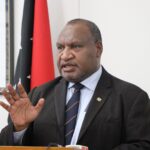
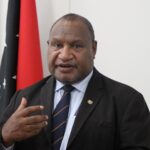


Prime Minister Hon. James Marape has welcomed signs that Papua New Guinea’s Independent Commission Against Corruption (ICAC) is moving decisively into its Investigation and Enforcement mandate, saying the developments reported prominently by both daily newspapers today demonstrate why his Government fought to establish and strengthen an independent Anti-Corruption institution.
Prime Minister Marape was responding to front-page reports in Post-Courier and The National today, concerning investigations, arrests and charges arising from ICAC operations involving Senior Public Officials, as well as reported attempts to obstruct or intimidate ICAC Officers in the execution of their duties. The Prime Minister commended Acting ICAC Commissioner Don Sawong and his Officers for hitting the ground running and demonstrating that the Commission is prepared to exercise the powers entrusted to it by Parliament. “I commend Acting Commissioner Don Sawong and his team at ICAC for hitting the ground running and getting on with the work that this important Institution was established to perform,” Prime Minister Marape said. “The Government has given ICAC the legal framework and continues to support the Institution with the resources necessary to do its job. Now ICAC must independently do that job without fear, favour or political interference. Every Public Servant and every person entrusted with public money should understand that there is nothing to fear from ICAC if you are doing the right thing. If your decisions are lawful, your records are in order and public money has been used for its intended purpose, then you should have no reason to fear accountability. It is those who choose to do the wrong thing who should be concerned about stronger accountability institutions.”
The Prime Minister said he would not comment on the merits of individual cases now before the Courts, stressing that every person charged is entitled to due process and the presumption of innocence. However, he said the broader development showed that the Institutional Reforms pursued by the Marape-Rosso Government were increasingly translating from Legislation and Policy into actual Enforcement. “This is precisely why my Government took the difficult but necessary step of completing the ICAC Legislation in 2020,” Prime Minister Marape said. “We did not establish ICAC as a decoration. We established it so that Papua New Guinea would have a strong, independent institution with the legal authority to investigate corruption wherever the evidence leads. Whether you are a Departmental Head, Provincial Administrator, Chief Executive, Finance Officer, Politician, Businessman or any other person dealing with public money, the law must apply equally. Public money belongs to the people of Papua New Guinea. It is intended for medicines, schools, roads, police, agriculture, electricity, water, infrastructure and services. Anyone entrusted with public money must be prepared to account for how it is used.”
ICAC LAW DELIVERED UNDER MARAPE GOVERNMENT
Prime Minister Marape said Papua New Guinea’s effort to establish an ICAC had been discussed for many years before his Government finally brought the Organic Law on the Independent Commission Against Corruption to passage. The Constitutional foundation for ICAC had been established earlier, and an initial Organic Law Bill was presented to Parliament in 2015 but did not progress before the 2017 National General Election. After taking Office in 2019, the Marape Government revived the Legislation, culminating in the unanimous passage by Parliament of the Organic Law on the Independent Commission Against Corruption on 12 November 2020. The Legislation established ICAC under Section 220B of the Constitution and gave the Commission extensive functions to prevent, investigate and combat corrupt conduct involving public officials, public bodies and, where applicable, private persons dealing with public resources. The Government’s wider Integrity Reforms during this period also included the Whistleblower Act 2020 and Amendments to the Proceeds of Crime Act, strengthening Papua New Guinea’s legislative architecture against corruption and illicit wealth.
The inaugural ICAC Commissioners were subsequently sworn in on 4 July 2023, enabling ICAC proper to become operational. Prime Minister Marape recalled that delivering ICAC had been politically difficult but remained one of the commitments he was determined to honour. “We passed the ICAC Law in 2020, and it almost cost me my Government. But I made a promise, and I intend to keep it,” Prime Minister Marape said. “I said then, and I repeat today: ICAC must be allowed to hold the powerful to account. The Government that passed the Law must also have the courage to allow that law to work. We cannot establish an Independent Institution and then become uncomfortable when it begins doing the job Parliament created it to do.”
NO POLITICAL INTERFERENCE WITH ICAC
Prime Minister Marape reiterated that the Government would not interfere in ICAC investigations, operational decisions or prosecutions. He said this principle remained particularly important following recent public discussion concerning ICAC’s leadership arrangements. The Prime Minister recently reaffirmed that Appointments and Acting Appointments to the Commission are governed by the Constitution and Organic Law and involve the legally constituted ICAC Appointments Committee, which includes the Prime Minister as Chair, the Leader of the Opposition, Chief Justice, Chairman of the Public Services Commission and Chairman of the Papua New Guinea Council of Churches. “ICAC must remain independent — including independent of me as
Prime Minister and independent of the Government of the day,” Prime Minister Marape said. “My responsibility is to help ensure that the institution has the law, resources and institutional support to perform its functions. It is not my responsibility to tell ICAC whom to investigate, whom not to investigate, whom to arrest or whom to prosecute. If there is evidence, let the law take its course. If somebody is charged, that person retains the right to defend himself or herself before an independent Court. That is how a Constitutional democracy must function. I want to make this clear to everyone in Government and across the country: do not fear ICAC if you are doing the right thing. ICAC exists to protect the integrity of our institutions and public resources. If ICAC comes asking legitimate questions, cooperate. If records are requested through lawful processes, provide them. If public funds have been properly spent, account for them. There should be nothing to hide. Those who are investigated or arrested through ICAC processes also retain their Constitutional and legal rights. An arrest or charge is not a conviction, and guilt or innocence is ultimately determined through our Courts. But no one should attempt to obstruct investigators simply because they do not want questions asked.” Prime Minister Marape also strongly condemned any attempt to intimidate, threaten, obstruct or interfere with investigators performing their lawful duties. “Nobody is above the law, and nobody has the right to threaten an officer because that officer is performing a lawful investigation,” he said. “At the same time, our investigators must always exercise their considerable powers professionally, impartially and strictly according to law.”
ACCOUNTABILITY ACROSS THE PUBLIC SERVICE
Prime Minister Marape said ICAC enforcement forms part of a much broader Government drive to restore accountability throughout the Public Service. In recent months, the Government has intensified requirements for Departments, Statutory Authorities, Provincial Governments and other Public Bodies to report on their performance and account for public funds entrusted to them. The Prime Minister has directed Ministers to review the performance of Agencies under their Portfolios and has placed Departmental and Agency Heads who failed to submit legally required 2025 Annual Performance Reports on notice. Government data presented recently showed significant gaps in compliance, including only 31 per cent compliance among Social Sector agencies and 9 per cent among Provincial Governments, while Economic Sector agencies recorded 73 per cent, Law and Order agencies 67 per cent and Administrative agencies 48 per cent. “This tells us why Accountability cannot simply be talked about — it must be enforced,” Prime Minister Marape said. “Government has allocated billions of Kina over many years for development and service delivery. The question I continue to ask is very simple: Where did the money go, what was delivered, and can the responsible Officers account for it? My job and the job of Government is to allocate Resources through Parliament. Those who receive those Resources have a legal and moral responsibility to account for them.”
NMCA TO FOLLOW THE MONEY
Prime Minister Marape said the establishment and strengthening of the National Monitoring and Coordination Authority (NMCA) provides another important layer in the Government’s accountability framework. NMCA has been tasked to strengthen monitoring of public expenditure and project implementation, including following public funds after they are released to determine whether expenditure reaches its intended destination and produces the outcomes approved by Government. The Authority is also able to draw upon independent accounting, engineering and technical expertise to verify expenditure and project delivery. “The role of NMCA is very clear — follow the money trail,” Prime Minister Marape said. “We cannot continue simply writing cheques and assuming that everything has happened because an expenditure appears in a Government ledger. We must connect every Kina spent with an actual result on the ground. ICAC investigates corruption. The Auditor-General audits. The Ombudsman Commission performs its Constitutional functions. Police investigate criminal conduct. Finance and Treasury maintain their respective financial responsibilities. NMCA follows implementation and expenditure. These institutions must complement each other to build a complete accountability system.”
GOVERNMENT INVESTING IN LAW, JUSTICE AND ANTI-CORRUPTION
Prime Minister Marape said the Government’s commitment is also demonstrated through substantially increased investment in the Law, Justice and National Security sectors. The 2026 National Budget allocated approximately K2.499 billion to the Law and Justice Sector, representing an increase of approximately K219.5 million, or 9.6 per cent, over the 2025 Budget. Within this broader commitment, ICAC’s 2026 allocation increased to approximately K54.1 million, representing a 34.5 per cent increase in funding over the preceding two years. The 2026 Budget also allocated K10 million specifically to activities addressing money laundering and counter-terrorism financing. The Government has simultaneously invested heavily in the wider Justice infrastructure, including the new Waigani National and Supreme Court complex, delivered at approximately K653 million, while strengthening Police, Magisterial Services, Correctional Services, Prosecution and other Institutions across the Justice system. “Fighting corruption is not achieved by one speech, one arrest, one Commission or one Government Department,” Prime Minister Marape said. “It requires strong Police, independent Courts, capable Prosecutors, properly resourced Anti-Corruption Agencies, transparent financial systems, effective auditing, good procurement systems and a public service culture that understands that every Kina must be accounted for. That is the institutional architecture we are building.”
FATF GREY LISTING MUST ACCELERATE REFORM
Prime Minister Marape said these Reforms have assumed even greater importance since Papua New Guinea was placed under increased monitoring — commonly referred to as the FATF Grey List — in February 2026. The Financial Action Task Force identified strategic deficiencies that PNG must address in its Anti-Money Laundering and Counter-Terrorism Financing framework. The Prime Minister said the Government was treating the grey-listing seriously and working with the FATF and Asia/Pacific Group on Money Laundering to address the required Reforms. Importantly, FATF itself acknowledged when PNG entered increased monitoring that the country had already made progress on several recommended actions, including operationalising and strengthening its Anti-Corruption authority, developing a National Risk Assessment and improving relevant systems. PNG’s Action Plan now includes strengthening its understanding of money- laundering risks, increasing money-laundering investigations and prosecutions, improving freezing and confiscation of criminal proceeds, strengthening international cooperation and addressing remaining technical deficiencies. “Our objective must be very clear: Papua New Guinea must work its way off the Grey List as quickly and credibly as possible,” Prime Minister Marape said. “We will not do that by pretending problems do not exist. We will do it by strengthening institutions, investigating financial crime, prosecuting cases where evidence exists, recovering proceeds of crime and improving the integrity of our financial system. Today’s evidence that ICAC is actively investigating and bringing matters before the Courts therefore contributes to a much bigger national objective — building confidence in Papua New Guinea’s institutions at home and internationally.”
“THE LAW MUST APPLY TO ALL OF US”
Prime Minister Marape said the fight against Corruption must ultimately transcend politics. He urged Ministers, Members of Parliament, Departmental Heads, Provincial Administrators, Chief Executives, Section 32 Officers, Procurement Officers, Finance Officers, Contractors and all people entrusted with public resources to understand that accountability standards are being progressively strengthened. “This Government is not claiming that Corruption disappeared when we came into office in 2019. Corruption and misuse of public resources are longstanding problems that have accumulated over decades,” Prime Minister Marape said. “What we can say is that we have progressively built stronger institutions and laws to confront them. We delivered the Organic Law on ICAC. We delivered whistleblower protection. We strengthened proceeds-of-crime legislation. We have increased funding for ICAC and the Law and Justice Sector. We established stronger national monitoring. We are demanding Performance Reports from agencies. We are strengthening financial systems and using technology to improve oversight. And now we are seeing these institutions increasingly exercise the powers Parliament gave them. There will be resistance. There will be political noise. There will be people who are uncomfortable when accountability reaches their doorstep. But this Government will not dismantle or weaken the institutions simply because they have begun to bite. The watchdog must be allowed to bite where there is evidence of wrongdoing. I again commend Acting Commissioner Sawong and the men and women of ICAC who are carrying out their responsibilities. Hit the ground running, do your work professionally, follow the evidence and apply the law without fear or favour. The Government will respect your independence.”
Prime Minister Marape also appealed to citizens to support lawful Anti-Corruption work by reporting credible information to the appropriate authorities rather than using allegations for political or personal purposes. “The fight against Corruption belongs to all Papua New Guineans,” he said. “If you have evidence, bring it forward. If public money has been stolen or misused, report it. If you hold public office, maintain proper records and account for every Kina entrusted to you. “And if ICAC, Police, the Ombudsman Commission, the Auditor- General, FASU or another lawful authority comes asking legitimate questions, cooperate. My Government’s position remains unchanged: no one is above the law — including those of us in political leadership. Papua New Guinea will become stronger when our people can trust that public office is about service and that public money reaches the people for whom Parliament intended it. Do the right thing and you have nothing to fear from ICAC. But if you choose to abuse public office or misuse public money, then you must expect our accountability institutions to do their job. That is the standard we are pursuing, and we will continue this work.”