





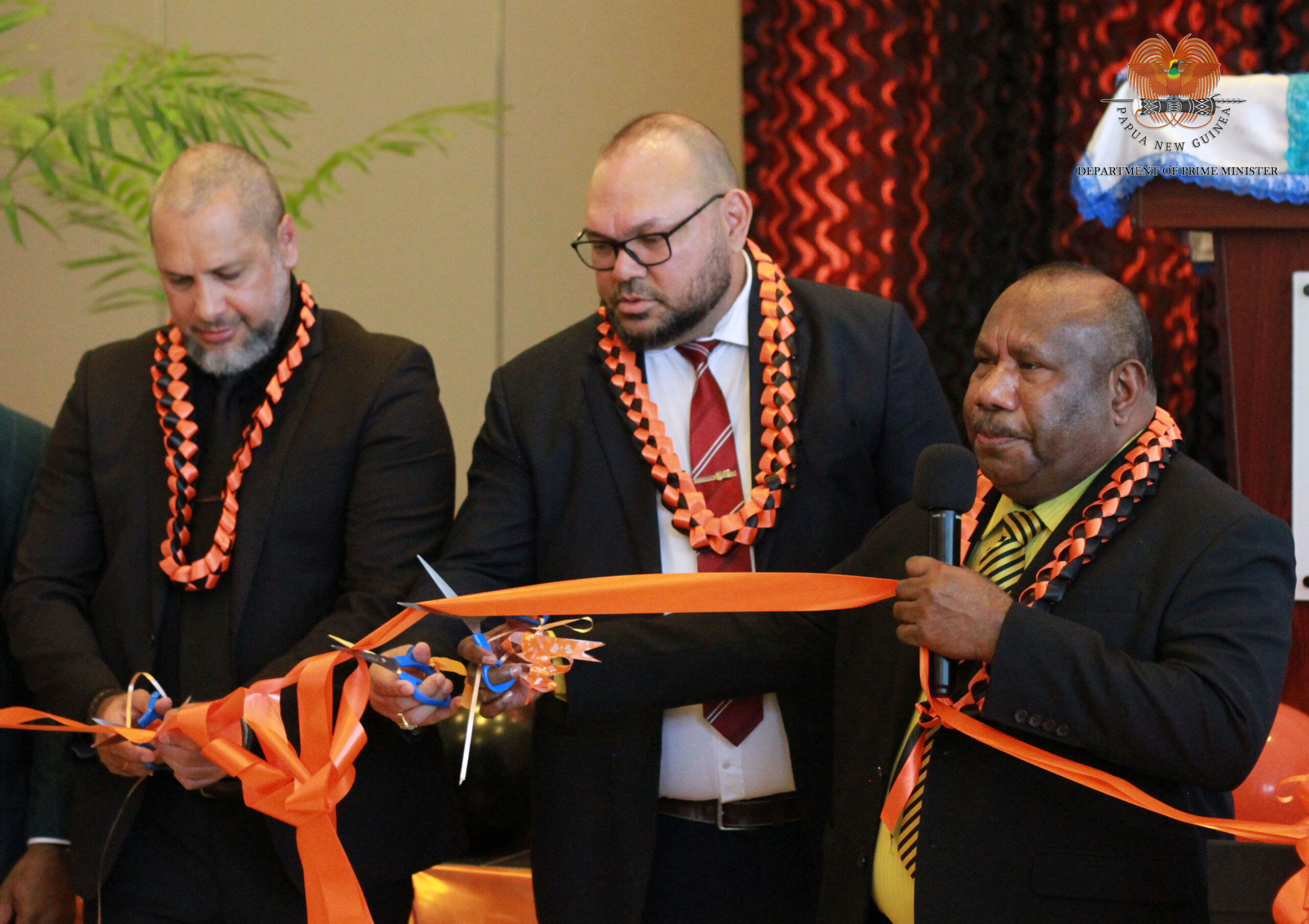

Prime Minister James Marape today officially launched the Department of Personnel Management’s (DPM) Public Service Payroll Office and set out a roadmap to strengthen public service ac- countability, efficiency, and integrity.
Prime Minister Marape said the return of payroll functions from the Department of Finance to DPM is part of a broader “reset” as Papua New Guinea moves into its 51st year, and stressed the importance of using technology to remove opportunities for corruption, nepotism and inefficiency.
“In this year of reset, we must eliminate human preferences and weaknesses that skew systems toward corruption and nepotism.
“Use ICT to remove those burdens. Use digital systems to ensure transparency and accountability.”
Key directions announced by the Prime Minister:
• One person, one position, one pay: Implement “Triple P” to clear ghost workers and duplicate payments by ensuring payroll records accurately reflect one position per individual.
• Digital ID for all public servants by December 31: Require every public servant to be digitally identified so there is a secure digital footprint for all public service transactions.
• Full use of ICT and AI: Expand and roll out ICT and AI tools from central agencies to all 21 provinces (including assistance to the Autonomous Bougainville Government) to improve recruitment, payroll, performance management and administration.
• Online recruitment and merit-based selection: Advertise public service vacancies online, use ICT and AI to shortlist and rank candidates, and eliminate patronage-based “one-talk” selection practices.
• KPI-driven contracts and performance management – Update and digitise staff appraisal systems and general orders (overhaul of the 1975 general orders). Link individual KPIs to Key Result Areas (KRAs), Medium Term Development Plans (MTDPs), and Vision 2050, and attach clear, performance-based contracts to department heads and all public serv- ants.
• Modernise human resources systems: Ensure every staff member has clear KPIs and link performance monitoring to payroll and contract renewal decisions.
Prime Minister Marape noted ongoing weaknesses in payroll and human re- source management, including past reliance on manual processes that allowed overtime, leave, and allowance irregularities.
He recalled previous public service structures and stressed that returning payroll to DPM must not reintroduce former problems.
Prime Minister Marape highlighted the scale of public service payroll: about 140,000 employees – roughly 1.4% of PNG’s population – receiving a significant portion of national expenditure, and urged that public funds must translate into efficient service delivery.
Prime Minister Marape thanked the Governor of Oro Province, Hon. Garry Juffa and the Parliamentary Committee on Public Sector Reform for initiating Deloitte’s review, and acknowledged agency heads, the Acting Commissioner of ICAC, the Defence Commander and other dignitaries present at the launch.
Implementation and next steps;
• Departments to begin digital ID enrolment immediately, with a target for full coverage by December 31.
• Central government to pilot ICT/AI hiring and payroll tools, then extend support and roll-out to provincial administrations.
• Ministries to ensure all staff have documented KPIs and contract terms linked to measurable outcomes.
Prime Minister Marape concluded by urging all public servants to embrace the reforms.
“If we fine-tune our public service, I do not mind paying K300 million a fortnight. But I would mind paying that if efficiency is below acceptable standards. Work faithfully. Deliver value. Serve our country.”