
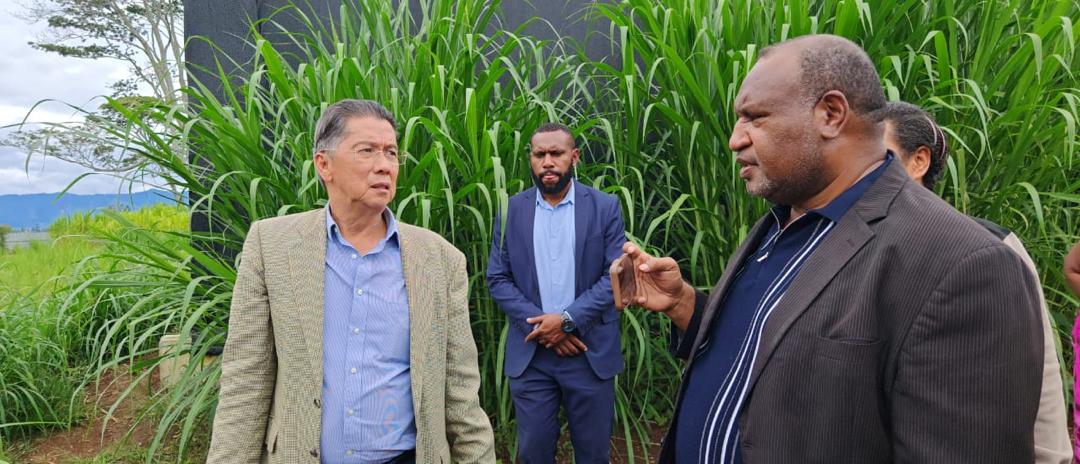

Prime Minister Hon. James Marape has highlighted Eastern Highlands Province as a key centre for Papua New Guinea’s agricultural transformation, following visits to major agricultural projects and community initiatives in the province over the Easter long weekend.
The Prime Minister said the province is demonstrating how policy, technology, and community participation can come together to drive agricultural industrialisation and strengthen food security.
“What I saw in Eastern Highlands confirms that agriculture can power our economy — from subsistence to commercial production, and ultimately to export,” Prime Minister Marape said.
Growing A Stronger Papua New Guinea in Our 50th Year
As Papua New Guinea celebrates 50 years of independence, the future of the nation is being planted in the soil of its own land.
Prime Minister Marape said projects such as the China Aid Juncao Technology and Upland Rice Technical Project are helping shape the next chapter of the country’s development.
“In the fertile highlands of Eastern Highlands Province and beyond, our farmers are learning new technologies that increase productivity, strengthen food security, and open new income opportunities for rural families,” he said.
The Prime Minister noted that upland rice technology is already delivering strong results, with yields reaching up to 8.5 tonnes per hectare, while improved cultivation methods allow multiple harvests from a single planting cycle.
“For many of our rural communities, this is a major step forward in growing more of our own food and reducing reliance on imports,” he said.
He added that Juncao grass technology is creating new opportunities in livestock and sustainable farming by providing high-quality feed while improving soil conditions.
In addition, Juncao mushroom cultivation is enabling farmers to produce significant volumes of nutritious food from small land areas, with the potential to harvest up to 120 kilograms per square metre annually.
“These innovations are not just technologies — they represent knowledge, cooperation, and opportunity,” Prime Minister Marape said.
“They show what can be achieved when international partnerships work alongside the determination and resilience of Papua New Guinean farmers.”
“As we mark our 50th year of independence, we are reminded that the true wealth of our country lies not only in our natural resources, but in the productivity of our land and the strength of our people.
“The next 50 years of Papua New Guinea will be grown by our farmers — one field, one harvest, and one innovation at a time.”
Technology Bridging Subsistence And Commercial Agriculture
Prime Minister Marape visited the China-supported Juncao Agriculture Technology Project, describing it as a critical bridge between traditional subsistence farming and modern, technology-driven agriculture.
“This is the model we want — where communities produce, and processing facilities create value and market access,” he said.
The Prime Minister noted that the project supports outgrower systems, where local farmers produce crops and livestock that are then processed and marketed through central facilities.
“This ensures income flows back to rural communities while building a sustainable agricultural value chain,” he added.
Coffee Processing and Local Investment
Prime Minister Marape also commended the Eastern Highlands Provincial Government for investing in a modern coffee processing facility within the agricultural precinct.
“This is a clear step towards industrialising agriculture — not just growing crops, but processing and adding value locally,” he said.
Local Innovation Driving Change
In addition to large-scale projects, the Prime Minister visited a Saemaul Undong (SMU) project at Kafana village outside Goroka, which applies a community-driven development model adopted from South Korea to produce poultry feed from cassava.
“These farmers told me, ‘You talk about agriculture — we hear you.’ And now they are doing it,” he said. He noted that chickens raised on locally produced feed were showing improved growth compared to traditional feed sources, highlighting the potential for reducing reliance on imports.
Kina For Kina Policy to Support Farmers
Prime Minister Marape reiterated that the Government’s Kina for Kina Policy is designed to support individuals, cooperatives, and businesses actively contributing to national priorities such as agriculture, import replacement, and rural development.
“This policy is about backing those who are already doing the work on the ground,” he said. “We will expand support for agriculture-based SMEs, especially those replacing imports and boosting local food production.”
Food Security as National Priority
The Prime Minister stressed that agriculture is central to Papua New Guinea’s long-term economic and national security.
“Globally, food and water will become the biggest security issues. A country that is food secure is protected from global shocks and imported inflation,” he said.
Call For Regional Agricultural Corridors
Prime Minister Marape identified key regions with strong potential for agricultural expansion, including Eastern Highlands, Western Highlands, Morobe, and Central Province.
“These regions, connected by major highways and ports, can become the backbone of our agricultural economy,” he said.
A Vision for Self-Sufficiency and Export Growth
Prime Minister Marape reaffirmed the Government’s commitment to transforming agriculture into a major economic driver.
“Our goal is simple — produce what we eat, and export the surplus,” he said.
“This is how we build a resilient, self-reliant, and prosperous Papua New Guinea.”