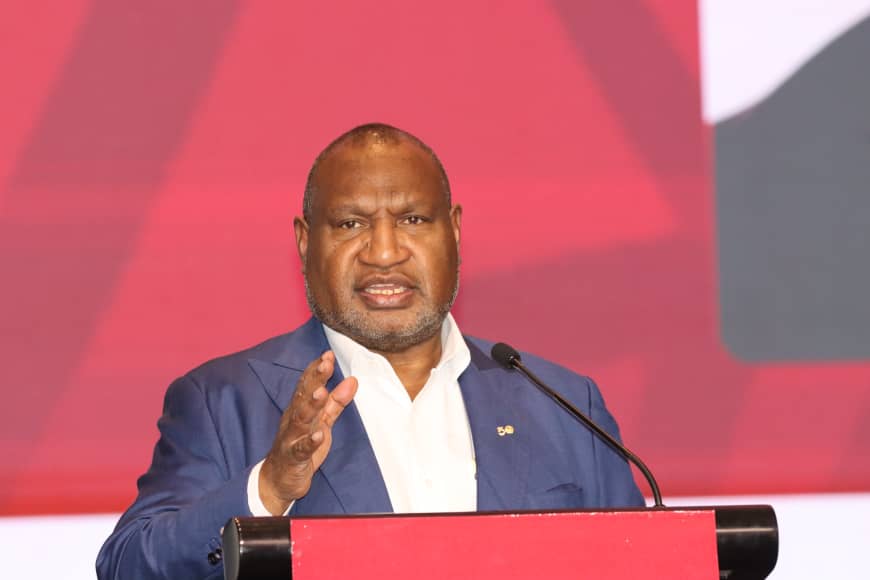

Prime Minister Hon. James Marape today emphasised the Government’s unwavering commitment to growing Papua New Guinea into a K200 billion economy, telling business leaders that sustained growth, diversification, and structural reform remain central to the nation’s future prosperity.
Speaking at the 16th Prime Minister’s Back-to-Business Breakfast in Port Moresby, Prime Minister Marape said Papua New Guinea’s 50th year of Independence was a defining moment for honest reflection and decisive action.
“Jubilee moments are not ceremonial pauses. They are moments for nations to assess honestly what has worked, what has not, and to deliberately set the foundation for the next phase of growth,” Prime Minister Marape said.
FROM RECESSION TO RECOVERY
Prime Minister Marape recalled that when his government took office in 2019, Papua New Guinea’s economy stood at approximately K79 billion, following a recession in 2018 marked by negative growth and declining confidence.
This fragile starting point was soon compounded by the COVID-19 pandemic in 2020, which disrupted global and domestic economic activity.
“We chose not to panic, not to abandon reform, and not to walk away from essential service delivery,” he said. “We stabilised the economy, protected development spending, and rebuilt from the ground up.”
Between 2019 and 2025, the Government added more than K50 billion to the size of the economy, lifting it to an estimated K132 billion in 2026, even before the full restart of major resource projects.
HARD DECISIONS AND MACROECONOMIC STABILITY
Prime Minister Marape said difficult but necessary decisions were taken to restore economic functionality, including allowing the kina to find its market value rather than maintaining an artificial peg.
“There was short-term pain, but long-term gain,” he said. “Today, foreign exchange is flowing, businesses can transact, and confidence is returning.”
He noted that Papua New Guinea has now recorded consistent economic growth averaging above 4 percent for five consecutive years, a first in the nation’s history, while inflation has remained contained below long-term averages.
DIVERSIFICATION BEYOND MINING AND PETROLEUM
The Prime Minister emphasised that Papua New Guinea’s future could not depend solely on mining and petroleum.
“Agriculture, fisheries, tourism, manufacturing, forestry, and human capital are all resources,” he said. “Our economy must be strong across every sector.”
He said the non-resource sector had delivered around four consecutive years of 4 percent growth, validating the Government’s strategy to broaden the economic base and reduce vulnerability to global commodity cycles.
SUPPORT FOR BUSINESS, LAND MOBILISATION AND EXPORTS
Prime Minister Marape reaffirmed strong Government support for SMEs, land mobilisation, export-driven growth, and import replacement, encouraging businesses to invest beyond major projects.
“If you need land to invest, come to Government. We will help unlock land for productive use and support serious investors,” he said.
He challenged businesses to reduce reliance on imported food and consumer goods, urging greater local production to keep wealth circulating within the country.
INFRASTRUCTURE, EDUCATION AND LAW AND ORDER
The Prime Minister highlighted major investments in power, roads, ports, airports, and connectivity, including more than K1.5 billion invested in electricity infrastructure over the past six years, supported by strong partnerships with development partners.
He also confirmed Cabinet approval of a K11 billion, 10-year education investment programme, describing education as a critical economic investment.
“Every child must leave school with real skills — academic, technical, or entrepreneurial — to contribute positively to the economy,” he said.
On law and order, Prime Minister Marape assured the business community that strengthening the law and justice sector remained a core priority, alongside reforms to state-owned enterprises and central government agencies to improve efficiency and accountability.
RESOURCE PROJECTS AND NATIONAL INTEREST
Prime Minister Marape said the Government remained engaged in detailed discussions on major resource developments, including Wafi-Golpu, Papua LNG, PNG LNG, Pasca A, and Porgera, stressing that agreements must deliver fair and long-term value for Papua New Guinea.
“I make no apology for insisting on better returns for our people,” he said. “We are securing arrangements that will stand the test of time.”
A LONG-TERM NATIONAL VISION
Looking ahead, the Prime Minister said the Government’s vision was clear: a larger, more diversified economy that could sustainably fund services, create jobs, and improve living standards.
“When the economy is bigger, businesses have room to grow, Government has the capacity to serve, and citizens have more opportunities,” he said.
Prime Minister Marape called on the private sector to partner with Government in building a stronger Papua New Guinea as the nation moves beyond its 50th year of Independence.
“Let us work together to grow this economy to K200 billion and beyond — for this generation and those to come.”