



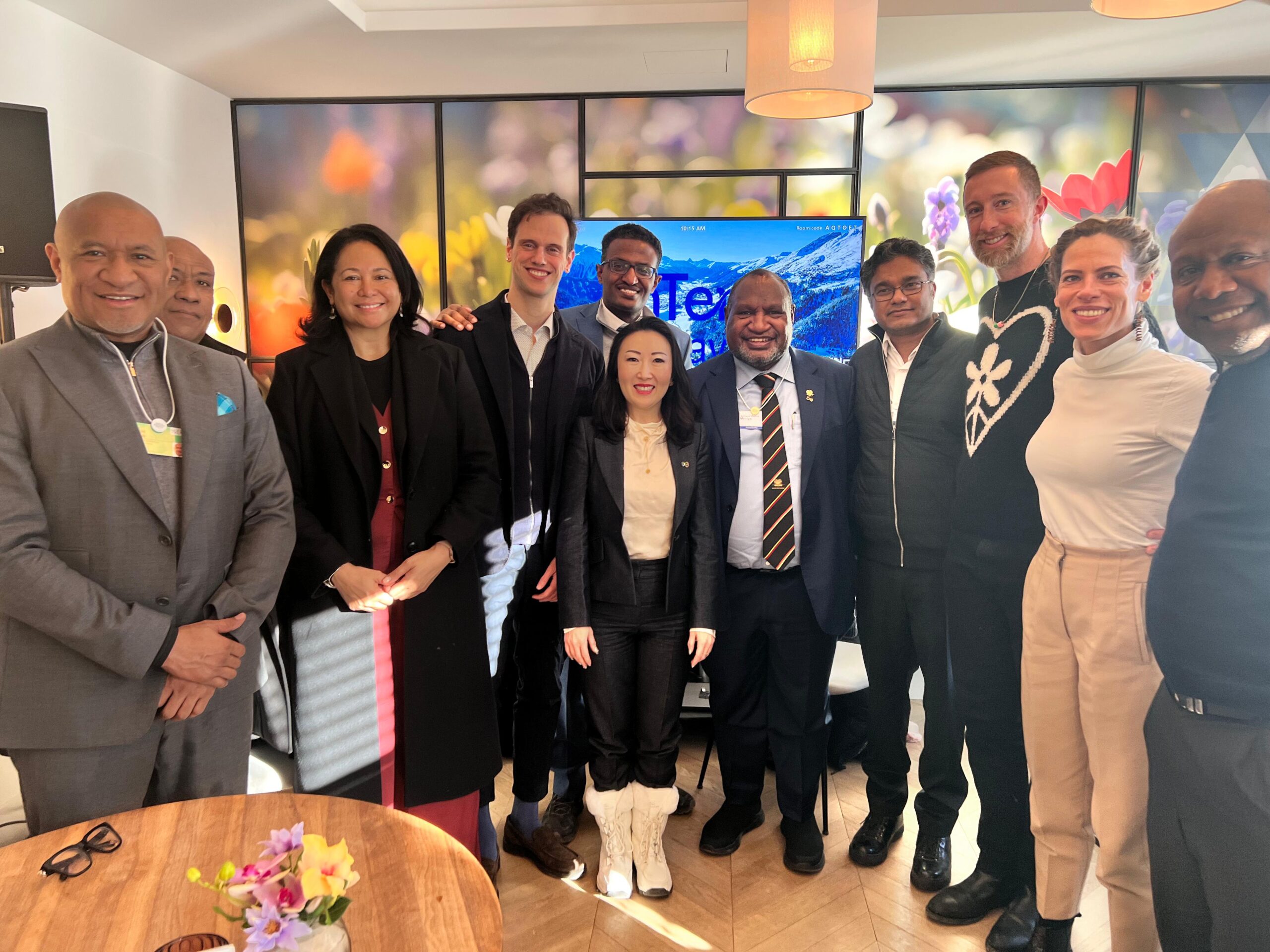

Prime Minister James Marape has reaffirmed his government’s commitment to transforming Papua New Guinea’s public sector through the strategic adoption of artificial intelligence (AI), following high-level discussions with young global IT and AI specialists on the margins of the World Economic Forum (WEF) Annual Meeting in Davos.
Prime Minister Marape said the meeting brought together some of the world’s emerging minds in artificial intelligence, each presenting advanced AI systems and capabilities with potential application across government operations.
The discussions were attended by PNG Chamber of Resources and Energy (PNG Core) President Mr Anthony Smare and focused on identifying world-class AI solutions that could be integrated into Papua New Guinea’s governance systems.
“This was a very productive meeting with young and highly capable AI specialists who have developed advanced technologies now being used globally,” Prime Minister Marape said.
“They demonstrated impressive AI features that have the capacity to fundamentally change how governments operate.”
The Prime Minister said Papua New Guinea is actively “shopping for the best AI system available globally” to support the Government’s Reset@50 reform agenda announced during the nation’s 50th Independence anniversary.
“Our intention is to incorporate artificial intelligence into government systems to reduce human emotion and human interference in critical decision-making processes,” he said.
“These include public service recruitment, elections administration, contract issuance, regulatory approvals, and the granting of licences and permits — particularly in key sectors such as forestry, mining, petroleum and lands.” Prime Minister Marape said excessive human discretion in these areas has historically contributed to inefficiencies, delays and perceptions of unfairness.
“Eliminating the human factor — human preference and selective decision-making — will strengthen transparency, meritocracy and national trust,” he said.
“In my view, this will help Papua New Guinea move faster toward becoming a modern, efficient and accountable state.”
He said technological advancement has reached a stage where artificial intelligence can dramatically improve productivity and service delivery.
“We are living in a time where ICT and AI have the capacity to ramp up efficiency and increase productivity at lightning speed,” Prime Minister Marape said.
“What we saw in these presentations is quite amazing — the number of capabilities that already exist in the world today.”
The Prime Minister said meetings at international platforms such as the World Economic Forum were crucial in connecting Papua New Guinea with leading innovators.
“The WEF brings together the best brains globally,” he said.
“The organisers deliberately bring government leaders together with private sector innovators, ICT experts and AI developers so ideas and partnerships can form.”
“Through this process, we were fortunate to engage directly with some of the best ICT minds currently operating globally.”
Prime Minister Marape said the discussions form part of a broader national effort already underway, including existing partnerships with leading academic institutions.
“My government has already been working with Queensland University of Technology,” he said.
“We are now looking to pool together the best ICT and AI proponents and developers worldwide.”
He said the ultimate objective is to procure an AI system that allows Papua New Guinea to leapfrog its current technological status.
“The product we adopt must lift us beyond incremental improvement,” Prime Minister Marape said.
“It must leapfrog our current systems to the best in the world — supporting efficiency, productivity, and merit-based decision-making across the public service.”
He said the use of artificial intelligence would be a cornerstone of modernising the public sector and driving national productivity.
“This is about building a public service that is faster, fairer, more accountable and future-ready,” he said.
“AI will not replace our people — it will empower them by removing bottlenecks, delays and inefficiencies.”
Prime Minister Marape said the Reset@50 agenda is focused on positioning Papua New Guinea for the next 50 years of nationhood.
“To remain competitive globally, we must embrace technology,” he said. “Artificial intelligence will be a key driver in strengthening governance, restoring public confidence and lifting national productivity for the benefit of all Papua New Guineans.”