

Prime Minister Hon. James Marape has strongly defended the 2026 National Budget, saying its theme of “Security with Growth” reflects the Government’s deliberate focus on restoring stability, strengthening institutions and positioning Papua New Guinea for long-term prosperity beyond its 50th year of independence.
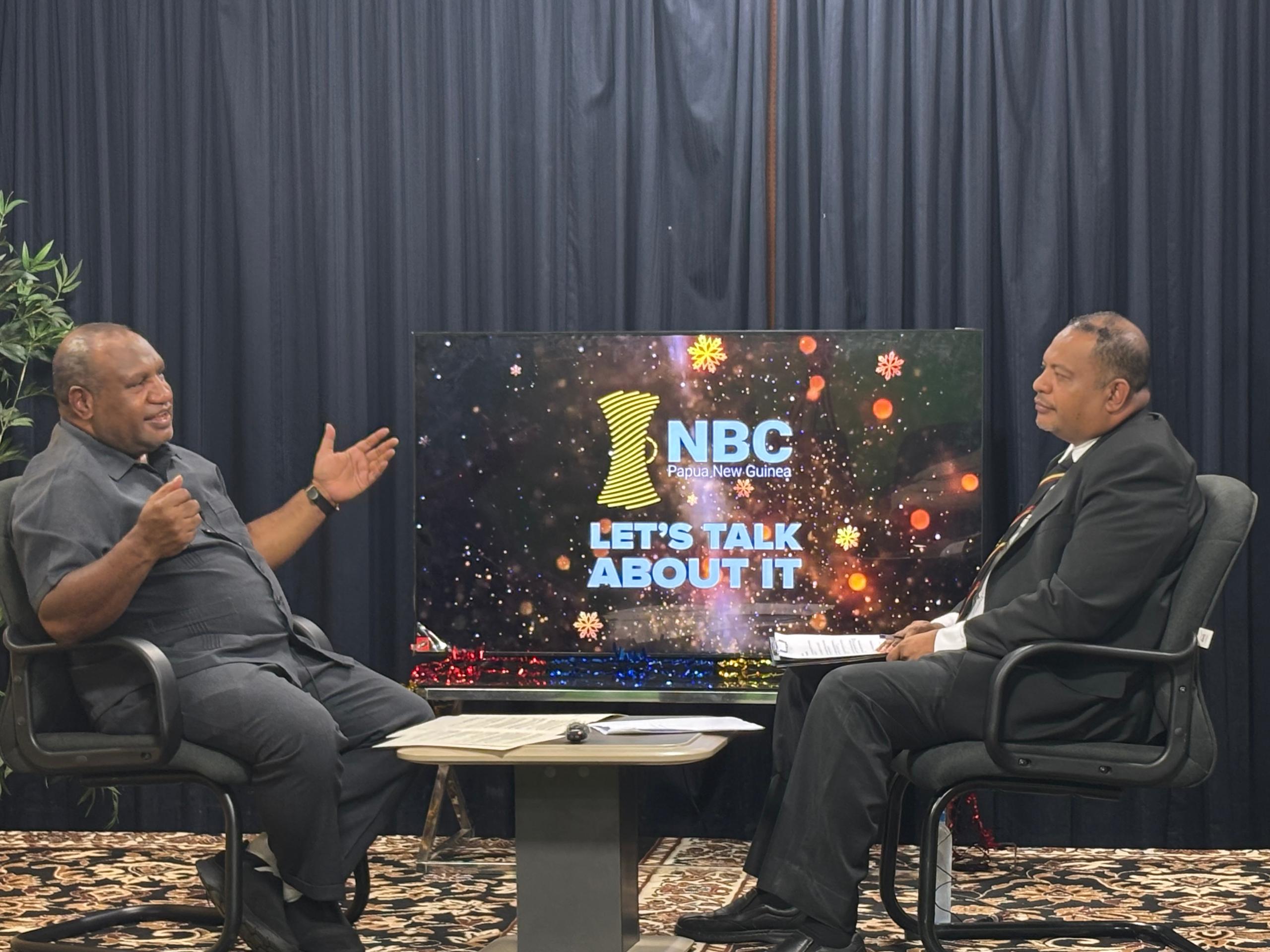
Speaking during an extended interview on NBC Talkback with host Steven Mase on Sunday evening, Prime Minister Marape said the 2026 Budget — the seventh under his administration — builds on reforms introduced since 2019 and addresses long-standing national challenges that have constrained growth and development .
“This is not a new government. This is our seventh budget,” Prime Minister Marape said. “We felt that without security, growth would not be possible — and growth itself also secures national security.”
Security Placed at The Centre of Economic Policy
The Prime Minister explained that the Budget’s emphasis on security goes beyond policing and law enforcement, extending to economic, social and institutional security.
He said insecurity — particularly unemployment, inequality and weak service delivery — has contributed to many of the social problems facing the country, and that addressing these issues requires sustained investment across sectors.
Law and order have been elevated to the top of Government priorities, with renewed police recruitment, increased judicial appointments, improved prosecution capacity and the formal payment of village court officials for the first time.
“We restarted police recruitment after years of no intake, we appointed more judges, reopened police cells, registered vehicles and put systems back in place,” he said. “This is not about patchwork solutions — it is about fixing the entire system.”
Digital Accountability and Use Of ICT
Prime Minister Marape also responded to criticism around accountability and transparency, saying the Government is strengthening oversight through digital systems and new technology.
He confirmed that a national monitoring and coordination authority has been established and that major investments in ICT platforms — including artificial intelligence — will be rolled out in 2026 to track government spending, contracts and public service appointments.
“My job is to allocate the money. Those who receive it must account for it,” he said. “We will use digital oversight to monitor funds in real time.”
He said departmental heads will be required to report on the use of their allocations early in the new year, as part of tighter financial discipline.
Health And Medicines: Funding Is Not the Only Issue
On health, Prime Minister Marape acknowledged public concern over medicine shortages but said the problem is not a lack of funding.
The 2026 Budget allocates more than K500 million for medical supplies, the largest such allocation in the country’s history.
“The issue is not always money — it is the system that procures, distributes and manages medicines,” he said.
He said Provincial Health Authorities now receive a minimum of K10 million annually for medical supplies and confirmed he will personally monitor the health system in early January to ensure procurement and distribution bottlenecks are addressed.
“If funding was the problem, every province would be complaining. Some are not — which shows it is also about management,” he said.
Deficit Reduction and Fiscal Discipline
Responding to debate over deficit budgets, Prime Minister Marape said Papua New Guinea is firmly on track to return to a balanced budget by 2027.
He said the deficit for 2026 has been reduced to 1.1 per cent of GDP, the lowest in 15 years and a significant improvement from the 8.9 per cent deficit recorded in 2021 following the COVID-19 pandemic.
“Our economy was K79 billion when we took office in 2019. Today it is about K133 billion and is projected to reach K145 billion next year,” he said.
He also noted that Papua New Guinea’s debt-to-GDP ratio is projected to fall to 45.5 per cent, well below the global average.
“Many countries operate at 90 per cent debt to GDP. The United States is above 120 per cent. Japan is over 260 per cent. We are managing our debt responsibly,”
he said.
Prime Minister Marape reaffirmed his commitment to delivering a balanced budget in 2027 and implementing the country’s first long-term debt repayment strategy.
Relief For Ordinary Papua New Guineans
The Prime Minister said fiscal reforms are already benefiting low-income earners and families.
He highlighted measures such as:
• Removal of income tax for those earning under K20,000 per year
• Removal of GST on 13 basic household items
• Stamp duty and GST relief for first-home buyers
• Continued tuition fee-free education through to tertiary level
“These are small amounts individually, but together they help families cope in difficult times,” he said.
He also pointed to increased funding for SMEs, including K200 million annually for small business lending, with special focus on women and grassroots entrepreneurs.
Infrastructure, Connect PNG And Aviation Challenges
On infrastructure, Prime Minister Marape reaffirmed the Government’s commitment to the Connect PNG programme, saying road access has already transformed livelihoods in remote areas.
He cited examples from Kikori, Gulf Province and Western Province, where new road links have allowed farmers and fishers to access markets, reduce transport costs and improve incomes.
“One person told me he now earns K16,000 a week selling seafood because of road access,” he said.
He acknowledged congestion and delays at major airports but said these challenges reflect increased demand and aging infrastructure.
He commended Air Niugini for its fleet modernisation, including the recent arrival of a new aircraft as part of PNG’s 50th anniversary programme, and said further restructuring is under way to improve service reliability.
Rural Electrification And 2030 Targets
Prime Minister Marape said the Government remains committed to achieving 70 per cent electricity access by 2030, primarily through grid expansion along major road corridors and off-grid solar solutions supported by development partners.
He said connecting rural communities to power will reduce urban migration and allow people to remain productive in their home areas.
A Call for Social Reset and Personal Responsibility
Reflecting on PNG’s 50 years of independence, Prime Minister Marape called for a national reset focused on basic values such as respect, timekeeping, lawful dispute resolution and community responsibility.
“Reset is not reinventing the wheel. It is going back to the basics,” he said.
He also shared a long-term vision of growing the economy to K200 billion by 2030 and K500 billion over the next 20 years, supported by ICT-driven governance, merit- based recruitment and reduced human interference in procurement and decision-making.
Promoting Healthy Lifestyles
In closing, Prime Minister Marape urged Papua New Guineans to adopt healthier lifestyles, warning that lifestyle diseases are shortening life expectancy.
“Cut sugar. Eat local food. Walk. Play sport. Prevention is better than cure,” he said, encouraging citizens to take personal responsibility for their health.
He thanked Papua New Guineans for their support during the country’s 50th anniversary year and called on citizens to actively participate in economic activities within their districts.
“I will do my utmost best, but nation-building is everyone’s responsibility,” Prime Minister Marape said.