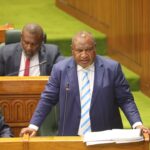
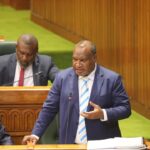
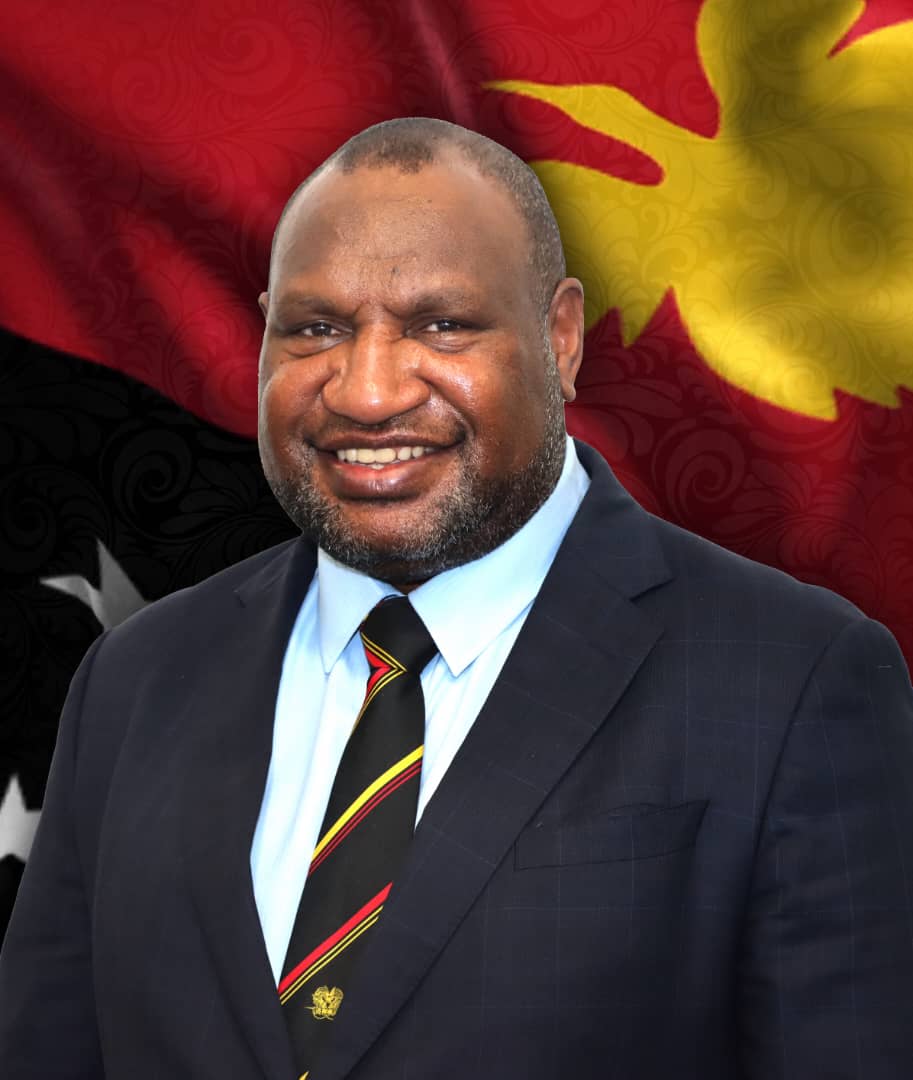

Prime Minister Hon. James Marape has praised Treasurer Hon. Ian Ling- Stuckey for delivering what he describes as “one of the most economically transformative Budgets in the history of our nation,” as Parliament received the 2026 National Budget yesterday.
The Prime Minister emphasised that the Budget arrives as Papua New Guinea celebrates its 50th Independence Anniversary and embraces the Reset@50 agenda, marking a new chapter of Economic discipline, national renewal, and growth-focused development.
He acknowledged the Treasurer for presenting a record K30.9 billion Budget, supported by expected Revenues of K29.3 billion, demonstrating that PNG’s Fiscal position has strengthened remarkably despite Global uncertainties. “I commend Treasurer Ling-Stuckey for another responsible, well-structured, and forward-looking Budget. This is not just another Financial Plan—it is a powerful statement of confidence in our country’s future,” PM Marape said.
Strongest Non-Resource Growth Run in PNG’s History
According to the Budget Speech by the Treasurer, PNG is experiencing its longest sustained period of real Non-Resource Sector growth, with annual real growth above 4% for six consecutive years (2021–2026)—a first in national history. Growth rates include:
4.2% in 2021
5.9% in 2022
4.7% in 2023
4.5% in 2024
4.6% in 2025
4.5% in 2026
Prime Minister Marape described these Figures as evidence that “PNG’s economic engine is no longer dependent on Resource-Sector booms alone—we are building a diversified, resilient, and broad-based national economy.”
Living Standards Rising Again
The Budget also confirms that real living standards, measured by GDP Per Capita, have finally recovered from the sharp decline experienced between 2014 and 2019. Living standards are projected to rise:
K8,949 per person in 2025, exceeding 2014 levels
K9,137 per person in 2026
The Prime Minister welcomed this turnaround:
“For years our people endured falling living standards. Today, the story has changed—families are beginning to feel the benefits of sustained economic expansion and targeted Government interventions.”
Strong Pathway to a Surplus by 2027
The 2026 Deficit has fallen to just 1.1% of GDP, down from 8.9% in 2020, positioning the country to achieve a Budget surplus by 2027. Debt-to-GDP is also projected to drop from 48.4% in 2025 to 45.5% in 2026. Marape stated:
“We are putting PNG back on a stable Fiscal trajectory. Responsible economic management is now the hallmark of the Marape–Rosso Government.”
A K145 Billion Economy in 2026
PNG’s Economy is expected to reach K145 billion in 2026, up significantly from K133 billion in 2025, and more than 80% larger than the K79 billion economy of 2018. The Government remains on track to achieve its transformative targets:
K200 billion economy by 2030
K300 billion economy by 2035
K1 trillion economy by 2048
Low Inflation & Growing Jobs
Inflation remains one of the lowest in PNG’s recent history, including a 0.6% rate in 2024 and –2.2% in the June quarter of 2025, with 2026 projected at 4.2%—well below historic averages. Formal job numbers increased 2.6% to June 2025, with rural job creation also rising due to strong agricultural commodity prices.
“Lower inflation means our people can finally breathe,” PM Marape said. “We are protecting household purchasing power and ensuring wage earners retain value in their incomes.”
A Budget Built for the Reset@50 Era
Prime Minister Marape concluded that the 2026 Budget embodies the aspirations of a nation entering its next 50 years with renewed discipline and economic confidence.
“This Budget is a declaration that Papua New Guinea is no longer a nation waiting for prosperity—we are building prosperity. As we enter our next 50 years, this Government commits to continue steering PNG toward stability, opportunity, and inclusive growth.”