




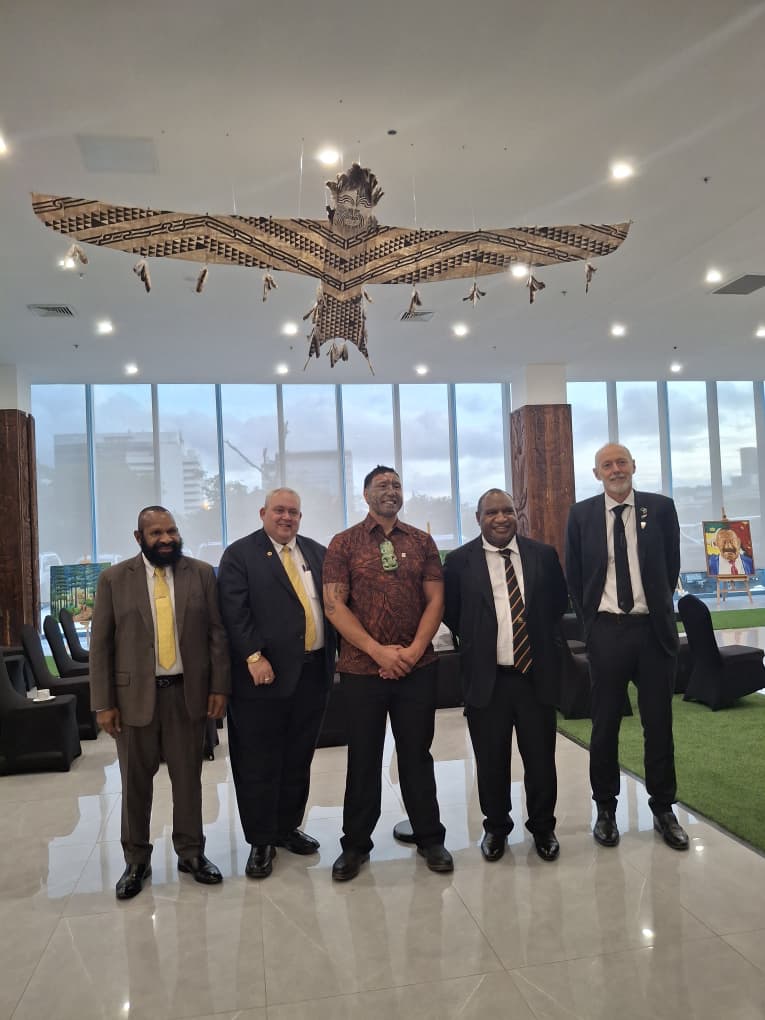

Papua New Guinea and New Zealand marked a significant milestone in their diplomatic relationship as New Zealand’s High Commissioner to Papua New Guinea, His Excellency Mr Peter Zwart, formally presented a Manu Aute Māori kite to Prime Minister Hon. James Marape on Thursday, 20 November 2025. The symbolic gesture commemorates both PNG’s 50th Independence Anniversary and the 50th year of bilateral ties between the two Pacific nations.
Held at Melanesian Haus in Port Moresby, the ceremony brought together senior government officials, New Zealand High Commission staff, and community representatives who came from New Zealand for the occasion.
High Commissioner Zwart: “New Zealand’s Pacific twin
In his address, High Commissioner Zwart said New Zealand and Papua New Guinea share deep cultural and geographical similarities that make their connection unique within the region.
He highlighted the countries’ shared mountain ranges shaped by the Pacific Ring of Fire, rich forests and birdlife, strong tribal identities, and long histories of navigation and exploration. He described PNG as New Zealand’s “Pacific twin,” reflecting a relationship rooted in heritage rather than merely diplomacy.
Prime Minister Marape: “A bond shaped by story, culture, and ancestry”
Prime Minister Marape thanked High Commissioner Zwart and described the gift as deeply meaningful to PNG’s identity as a Pacific nation.
“This is more than a ceremonial exchange. It is a moment of shared story, shared respect, and shared continuity as people who have lived in the Pacific for thousands of years.”
PM Marape linked the Manu Aute’s tapa work to PNG’s own tapa traditions, especially from Oro Province, saying this artistic synergy reflects the authenticity of the relationship.
He also used a traditional Huli metaphor to illustrate the cultural significance: “A bird does not fly to an unknown destination — it sits on another tree. Today, the bird from your tree has come to ours.”
Charting the next 50 years
Both leaders affirmed that the ceremony marks the start of a more ambitious chapter in PNG–NZ relations. Future cooperation will focus on expanding trade, strengthening cultural and educational exchanges, promoting climate resilience, and deepening regional collaboration.
The Manu Aute will be displayed at Melanesian Haus, near Parliament and the Courts — a symbol of PNG’s partnership with New Zealand woven into the national story.
The Manu Aute: A soaring symbol of unity
The centrepiece of the ceremony was the presentation of the Manu Aute, a traditional Māori kite crafted by master weavers and inspired by:
• Te Amokura — the red-tailed tropic bird, common in PNG and a rare, auspicious sign in Aotearoa; and
• Toroa — the wandering albatross, a New Zealand bird known for long voyages across the Pacific, including into PNG’s warm latitudes.
High Commissioner Zwart said the kite represents connection, aspiration, and interwoven Pacific identity: “The Manu Aute catches the wind and soars. May it lift our imagination and ambition for what the next 50 years of partnership can become.”
Accompanying the kite were two mauri stones, each representing spiritual grounding and shared custodianship of the relationship:
• A Pounamu (greenstone) mauri stone gifted to Prime Minister Marape; and
• An obsidian mauri stone retained by the New Zealand High Commission, acknowledging ancient Pacific trade links between East New Britain and Aotearoa.
In Māori culture, mauri refers to the life force or essence present in all things — living beings, landscapes, waters, and ancestral objects. A mauri stone is an item entrusted to carry and protect that life force.
• They symbolise unity, trust, and shared responsibility.
• They are used in ceremonies to strengthen relationships and safeguard important places.
• They represent continuity between ancestors, present generations, and future custodians.
Pounamu Mauri Stone (gifted to PM Marape)
• New Zealand’s most sacred stone
• Symbol of chieftainship, leadership, and respect
• Traditionally worn or held by leaders and elders
Obsidian Mauri Stone (kept by NZ High Commission)
• Volcanic glass historically traded across the Pacific
• The largest ancient quarries were in East New Britain and New Zealand’s Bay of Plenty
• Represents shared ancestry, craftsmanship, and ancient inter-island exchange
Together, the Manu Aute and the mauri stones symbolise both aspiration (soaring into the future) and grounding (rooted in shared heritage).